Long Philtrum: What It Means, How to Measure It, and What Photos Miss
A practical, non-judgmental guide to the space between the nose and upper lip, including measurement landmarks, natural variation, photo distortion, and safe interpretation.
FaceAnalysis.org Editorial Team
We explain photo-based facial proportions in plain language and separate useful observation from medical or beauty claims.
Review standard: Checked against anatomy references, anthropometric research, and conservative photo-measurement principles.

A long philtrum usually means the visible distance between the base of the nose and the upper lip appears longer than expected within a particular face. The philtrum itself is the vertical groove in the center of that area, bordered by two subtle ridges. Online discussions often use philtrum length to describe the full nose-to-upper-lip distance, even though the groove and the measured region are not exactly the same thing.
There is no universal selfie number that separates a normal philtrum from a long one. Anthropometric studies use defined landmarks and population-specific samples, while casual online comparisons often rely on cropped photos, different head positions, makeup, expression, or camera distance. A useful reading therefore starts with landmarks and overall facial balance, not a beauty verdict.
This guide explains the anatomy, shows a repeatable photo method, compares philtrum length with the lower facial third, and describes when a health professional—not an online proportion page—is the appropriate source.
What Does a Long Philtrum Mean?
In everyday appearance language, long philtrum describes a relatively tall region between the nose and upper lip. It may look long because the subnasale-to-labiale-superius distance is greater, because the upper lip is visually thin, because the nose base sits higher, or because the chin and lower face create a contrasting proportion. The groove may be deep, shallow, smooth, narrow, or prominent independently of its length.
Natural variation is expected. Age, growth, sex-related averages, ancestry or population background, lip posture, dental support, and soft tissue all influence the region. A long-looking philtrum does not by itself identify a syndrome, health problem, or treatment need. Clinical assessment considers many features and history together; a single photo label cannot do that.
It is also important to separate philtrum length from midface length. The midface commonly refers to a larger central facial region, while the philtrum is only the area immediately below the nose. A person can have a visually long philtrum without a long midface, and the reverse can also occur.
How to Measure Philtrum Length from a Photo
For a rough photo check, use a sharp front-facing portrait with a neutral expression. Mark the subnasale—the point where the nose base meets the upper lip region—and the labiale superius, the midpoint of the upper vermilion border. Measure the vertical pixel distance between those landmarks. Pixels are sufficient when you compare proportions inside the same image; they are not a reliable real-world millimeter measurement unless the photo includes calibrated scale and controlled perspective.
Then compare the distance with adjacent regions rather than treating it alone. Useful context includes visible upper-lip height, chin height, nose length, and the lower facial third from the nose base to the chin. Repeat the check on a second photo taken at a similar distance. If the result moves noticeably, image setup is likely driving part of the impression.
| Check | Use | Avoid |
|---|---|---|
| Top landmark | Subnasale at the base of the nose | Starting at the nostril edge or nose tip |
| Bottom landmark | Center of the upper lip border | Measuring to the mouth opening or lower lip |
| Expression | Relaxed, closed lips | Smile, lip purse, or raised upper lip |
| Camera | Eye level and natural portrait distance | Close wide-angle selfie or tilted phone |
| Interpretation | Compare with nearby facial regions | Use one universal ideal number |
- Use the same two landmarks every time.
- Measure vertically rather than following the curve of the skin.
- Compare photos only when crop, angle, and expression are similar.
- Treat the result as a photo proportion, not a clinical measurement.
Why the Same Philtrum Length Can Look Different
The eye reads relationships, not isolated distances. A fuller upper lip can make the nose-to-lip area feel shorter; a thin upper lip can make the same measured distance feel longer. A taller chin can distribute the lower face differently, while a shorter chin can make the philtrum region more visually dominant. Nose projection, columella show, dental support, and the angle between the nose and upper lip also change the side-profile impression.
This is why ratio-based context is more useful than a stand-alone label. Facial thirds describe broader vertical balance, and a facial proportions guide can place the philtrum beside nose, lip, and chin relationships. None of these frameworks establishes an objective beauty standard. They simply provide vocabulary for describing a photograph.
Style can also change perception without changing anatomy. Lip color, overlining, facial hair, lighting, shadow, and camera focal length can all make the region appear shorter or longer. Those effects matter when comparing social-media images or before-and-after claims.
Why a Philtrum Looks Longer in Some Photos
Close phone selfies exaggerate central facial features and can alter the balance among the nose, lips, and chin. Looking slightly downward may compress one region while stretching another; looking upward changes the visibility of the nose base and upper lip. Smiling shortens and reshapes the visible area because the upper lip rises. Even a neutral-looking expression may include lip tension that changes the lower landmark.
For a cleaner comparison, place the camera at eye level, step back to a normal portrait distance, use moderate zoom if needed, keep the head level, and use even light. Take both a front view and a true side view. Do not compare a close selfie with a professionally photographed portrait and assume the difference represents anatomy.
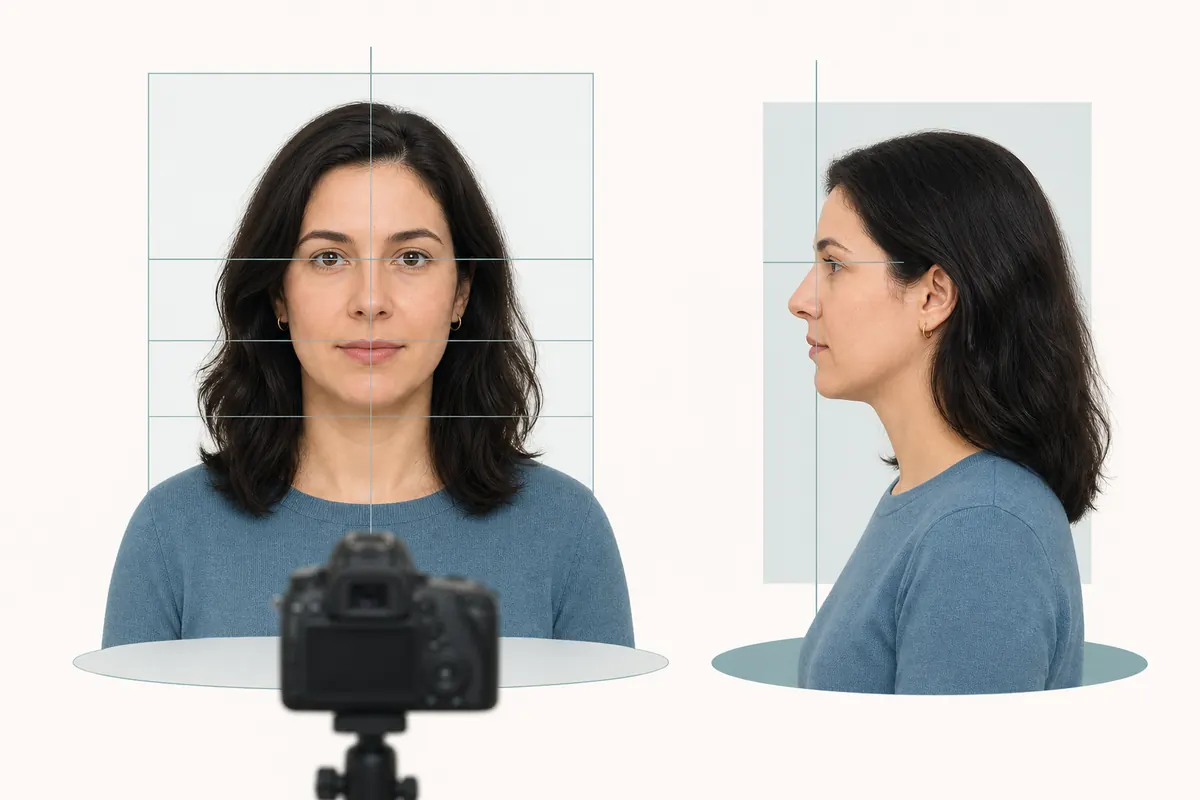
How to Interpret a Long Philtrum Safely
Start with a neutral description: the nose-to-upper-lip region appears relatively long in this image. Then ask whether the result persists across two controlled photos and whether the surrounding proportions explain the impression. Avoid converting the observation into claims about attractiveness, personality, ethnicity, aging rate, or health.
If the concern is purely cosmetic, an online guide can help you understand terminology but cannot recommend a procedure. Lip lifts, fillers, orthodontic changes, and other interventions have different risks and indications. Only a qualified clinician who examines the full face and medical history can discuss whether any treatment is appropriate. Never use a face-analysis score to choose a procedure.
If a facial difference appeared suddenly, follows injury, affects movement or sensation, or comes with weakness, speech difficulty, or drooping, it is not a proportion question. Seek prompt medical evaluation. For a stable lifelong feature, natural variation is usually the most useful starting point.
- Use descriptive language rather than good/bad labels.
- Check more than one consistent photo.
- Keep cosmetic questions separate from medical diagnosis.
- Discuss procedures only with appropriately qualified professionals.
Long Philtrum FAQ
References and Further Reading
Place the Philtrum in Full-Face Context
Use broader facial proportion guides before drawing conclusions from one small region or one photo.