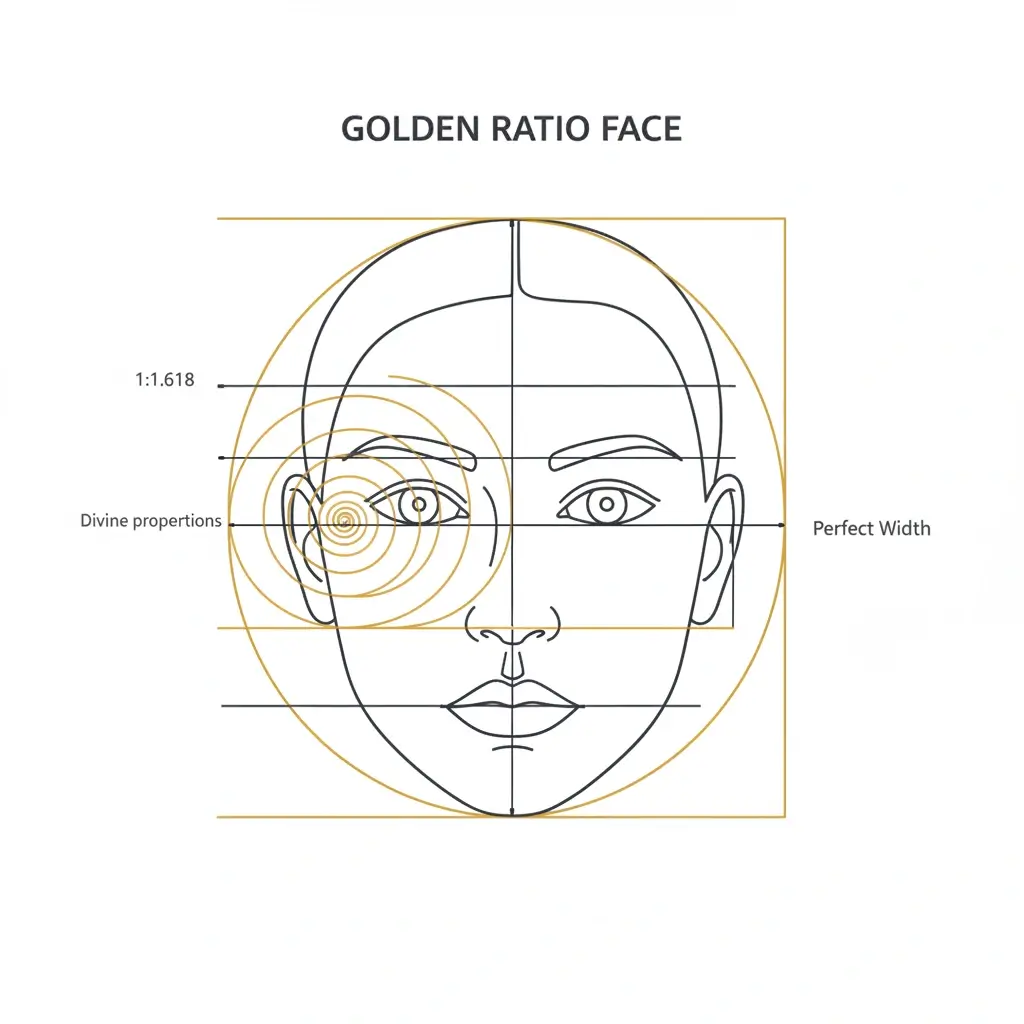
Golden Ratio Face Calculator

Upload a clear front-facing photo to use our golden ratio face calculator and estimate how your visible face proportions compare with phi-based facial balance. The result explains your golden ratio face score, facial harmony score, face ratio, and facial thirds test in practical terms instead of treating one number as a beauty verdict.

Golden ratio face calculator visual example Front-facing selfie example for face proportion analysis

Upload Your Photo for a Golden Ratio Face Test

Use a straight, evenly lit selfie with your full face visible. A natural camera distance helps the golden ratio face calculator read face proportions and facial thirds more reliably.

How to Use the Golden Ratio Face Calculator

Step 1

Upload a Clear Front-Facing Photo

Start with a portrait where your face is straight to the camera, both sides are visible, and the image is not heavily filtered. The golden ratio face calculator needs a clean view of your eyes, brows, nose, mouth, cheeks, jawline, and chin to estimate face proportions with useful confidence.

Step 2

AI Reviews Face Proportions and Face Ratio

The tool maps visible facial landmarks and compares selected distances such as face length, face width, eye spacing, nose width, mouth width, and facial thirds. This creates a photo-based face ratio estimate rather than a fixed statement about your natural appearance from every angle.

Step 3

Read the Result as a Proportion Guide

Your golden ratio face score shows how closely the measured photo aligns with selected phi-based references. Use the result to understand facial harmony, not to chase a perfect face. A useful golden ratio face calculator explains what influenced the score and what can change it.

What the Golden Ratio Face Calculator Measures

A useful golden ratio face calculator does more than compare one line to 1.618. It looks at several face proportions that shape visual balance.

Face Length-to-Width Ratio

The calculator estimates how your visible face length compares with face width. This face ratio is one of the clearest proportion signals, but it can shift when a selfie is taken too close or from a tilted angle.

Facial Thirds Test

The facial thirds test compares the upper, middle, and lower face. It helps explain whether the vertical balance of the photo feels even, while still allowing for hairstyle, expression, and natural variation.

Feature Spacing

Eye spacing, nose width, mouth width, and their relationship to the wider face all influence a golden ratio face result. These signals help the tool move beyond a single headline score.

Facial Harmony Score

The facial harmony score combines visible proportion cues with overall balance. It is best read as a geometry-based guide to facial harmony, not as proof that one face is better than another.

This golden ratio face calculator reads the uploaded photo. It is for cosmetic, educational, and entertainment use only, not for medical, dental, orthodontic, or surgical evaluation.

How to Read a Golden Ratio Face Score

Most users want to know whether a number is good. The better question is what the golden ratio face calculator actually measured.

85-100

Strong Alignment

A score in this range usually means the visible face proportions in this photo align strongly with selected golden ratio references. It does not mean the face is perfect. It means the measured face ratio, facial thirds, and feature spacing read as highly balanced in this image.

70-84

Balanced Alignment

This is a common useful result. The golden ratio face calculator sees generally balanced face proportions, with a few natural differences in vertical thirds, face width, feature spacing, or symmetry. Many clear front-facing photos fall in this range.

55-69

Mixed Alignment

A mixed score usually means some measured proportions are close to the reference model while others differ more visibly. That can be natural, but it can also happen when the camera angle, lens distance, smile, or hairline changes how the face is presented.

Below 55

Photo-Sensitive Result

A low score should be read carefully. The photo may be tilted, very close, shadowed, filtered, or partly covered, which can distort face ratio and facial thirds. Try another front-facing portrait before treating the result as meaningful.

A golden ratio face score is a structured estimate, not a universal beauty standard. Real facial attractiveness also involves symmetry, expression, skin appearance, grooming, cultural context, and personal preference.

A Golden Ratio Face Calculator Is a Proportion Tool, Not a Beauty Verdict

The strongest search intent behind a golden ratio face calculator is simple: users want to upload a photo and see whether their face proportions feel balanced. The important part is explaining the score honestly. Golden ratio references can be useful when they organize measurements such as face length, face width, eye spacing, nose width, lip width, and facial thirds. They become less useful when a tool pretends that one number defines beauty. Modern facial aesthetics research does not support the idea that every attractive natural face follows 1.618 exactly. A better approach is to treat the golden ratio face score as a visual reference. It can help you understand why one photo reads balanced, why another photo feels distorted, and how proportion cues work together with symmetry and expression.

Golden ratio face calculator showing face proportion reference

Golden Ratio Face vs Face Symmetry: They Are Related but Different

Many users confuse a golden ratio face test with a face symmetry test. They overlap, but they measure different ideas. Face symmetry focuses on left-right balance: whether the eyes, brows, cheeks, nose, mouth, and jawline appear evenly aligned around the visible center line. Golden ratio analysis focuses more on face proportions, including face length-to-width ratio, vertical facial thirds, and feature spacing. A face can be fairly symmetrical and still have proportions that differ from a phi-based reference. A face can also have strong proportional balance while showing normal left-right asymmetry. That is why this page separates the golden ratio score from the facial harmony score and still links the two concepts together.

Golden ratio face and face symmetry comparison example

Use Face Proportions to Improve Photos, Styling, and Self-Understanding

The best use of a golden ratio face calculator is practical, not judgmental. If a close selfie lowers your face ratio score, you may learn that the lens is exaggerating the center of the face. If facial thirds look more balanced in a neutral portrait than in a smiling snapshot, you may learn how expression changes the lower face. If feature spacing looks different with a new hairstyle, glasses frame, beard line, or makeup placement, the result gives you a structured way to compare options. In other words, golden ratio face analysis is most helpful when it supports better photo choices and styling experiments, not when it turns your appearance into a rigid pass-or-fail test.

Face proportions used for portrait and styling decisions

How to Get a More Reliable Facial Thirds Test

The golden ratio face calculator depends on the photo. A clean image makes face proportions, face ratio, and facial thirds easier to read.

Use a Straight-On Portrait

Face the camera directly and keep your head level. A tilted or angled selfie can change face width, jawline visibility, and facial thirds, which can shift the golden ratio face score.

Choose Even Lighting

Strong side light can hide one cheek, change the nose shadow, and make feature spacing look uneven. Soft, even light gives the calculator a cleaner read on facial harmony.

Keep a Neutral Expression

A big smile can raise the cheeks, widen the mouth, and shorten the lower face in a still image. A neutral expression usually gives the most useful facial thirds test.

Avoid Close Wide-Angle Selfies

Very close phone photos can exaggerate the nose and center of the face. A natural portrait distance helps the face ratio and golden ratio face calculator result stay more stable.

If two photos produce different results, compare the angle, expression, light, and camera distance before assuming your face proportions changed.

Golden Ratio Face Calculator FAQ

What is a golden ratio face calculator?

A golden ratio face calculator is an online tool that estimates how selected face proportions in a photo compare with phi-based facial balance references. It usually looks at face length, face width, feature spacing, facial thirds, and overall facial harmony. The result is a photo-based estimate, not a permanent judgment of your face.

What does my golden ratio face score mean?

Your golden ratio face score shows how closely the visible measurements in the uploaded photo align with the calculator's selected proportion references. A higher score means stronger alignment in that image. It does not prove that a face is objectively better, more attractive, or closer to perfection.

Is a higher golden ratio face score always better?

No. A higher score can indicate balanced face proportions in one photo, but beauty and facial harmony are broader than 1.618. Expression, face symmetry, skin appearance, style, confidence, culture, and personal preference all affect how a face is perceived. Use the score as a reference, not a final verdict.

What is the difference between golden ratio face and facial symmetry?

Golden ratio face analysis focuses on proportion relationships, such as face ratio, facial thirds, and feature spacing. Facial symmetry focuses on left-right balance. A good face analysis can include both, but they are not the same measurement and should not be interpreted as one identical score.

What photo works best for a facial thirds test?

Use a clear front-facing portrait with your whole face visible, even lighting, neutral expression, and natural camera distance. Avoid strong filters, extreme close-ups, side angles, screenshots, and photos where hair covers the brows, cheeks, jawline, or chin.

Can the golden ratio face calculator diagnose medical or dental issues?

No. This tool is for cosmetic, educational, and entertainment use only. It estimates visible face proportions from a photo. It is not a medical, dental, orthodontic, psychological, or surgical assessment and should not be used as professional advice.

Why did my face ratio result change with another selfie?

Camera distance, lens distortion, head tilt, smile, lighting, and hairstyle can all change how face proportions appear. A close selfie may widen the center of the face, while a tilted image can change facial thirds and jawline balance. Try a clean portrait if you want a more stable comparison.

Is my uploaded photo private?

Face photos are sensitive, so you should always read the site's privacy policy before uploading. FaceAnalysis.org processes uploaded images for analysis and does not present the tool as a permanent public photo library. Check the privacy policy for current details about handling and retention.