Facial Harmony Guide: Meaning, Examples, and How to Read Your Face Balance
A practical, non-surgical guide to facial harmony: what the term means, which proportion cues matter, why photo results change, and how to compare harmony with symmetry, facial thirds, golden ratio, and face shape tools.
Written by
FaceAnalysis.org Editorial Team
AI face analysis editors
We review face-analysis tool UX, interpretation patterns, and search intent so readers can understand what a photo-based result is actually showing.
Review standard
Checked against current SERP structures, Similarweb/Semrush keyword data, and the behavior of FaceAnalysis.org proportion tools.
This page links to our free analysis tools when they help readers test a concept directly.
How this guide was built
We selected facial harmony because it has distinct informational intent from existing symmetry, golden ratio, facial thirds, and face shape pages, then built this guide as a neutral interpretation hub.
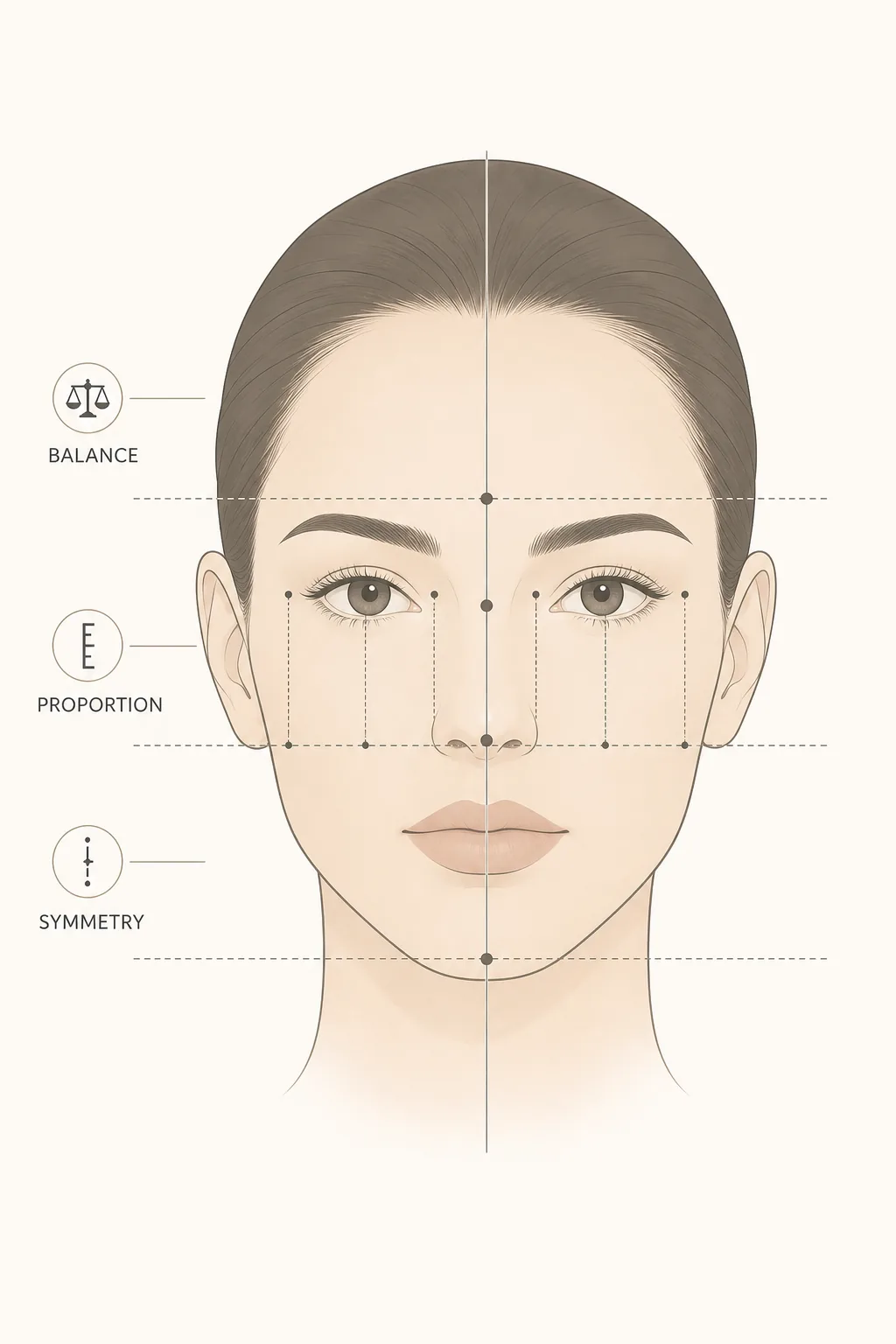
Facial harmony means the visible parts of a face feel balanced together. It is not one exact measurement and it is not a medical label. In everyday face analysis, the phrase usually describes how proportions, symmetry, feature spacing, facial thirds, face shape, and expression work together in a photo.
That distinction matters because many search results treat facial harmony like a before-and-after cosmetic term. For most readers, a more useful question is simpler: why does one photo look balanced, why does another look slightly off, and which signals should you compare before trusting an AI face analysis result?
This guide gives the direct answer first, then shows a practical way to read facial harmony without turning one selfie into a permanent verdict.
What Is Facial Harmony?
Facial harmony is the overall impression of balance between facial features and proportions. A harmonious face does not need perfect symmetry or mathematically identical sections. It usually means the major visual cues do not fight each other: the eyes feel placed naturally, the midface does not feel heavily stretched by the photo, the jaw and chin fit the outline, and the upper, middle, and lower face read coherently.
In AI face analysis, facial harmony is best treated as a summary concept. It pulls together several smaller observations rather than replacing them. A symmetry score can explain left-right alignment, a golden ratio calculator can compare proportions, and a face shape detector can describe outline. Facial harmony asks how those pieces feel when seen together.
The most important limitation is that harmony is partly photo-dependent. Camera distance, head angle, expression, hairstyle, facial hair, and lighting can all change the reading.
Short answer
Facial harmony means the face's visible proportions, spacing, symmetry, and outline work together in a balanced way. It should be read as context, not as a pass-or-fail beauty verdict.
The Main Signals Behind Facial Harmony
A useful facial harmony check separates the concept into smaller signals. That makes the result easier to understand and reduces the chance of overreacting to a vague score.
The table below shows the cues that most often affect whether a face reads as balanced in a portrait.
| Signal | What it describes | Helpful related page |
|---|---|---|
| Symmetry | How evenly visible features align from left to right | Face Symmetry Test |
| Vertical thirds | Whether upper, middle, and lower face sections feel balanced | Facial Thirds Guide |
| Golden ratio cues | How several face proportions compare at once | Golden Ratio Face Calculator |
| Face shape | The outline, jaw, cheekbone, and forehead relationship | Face Shape Detector |
| Feature spacing | How eyes, nose, lips, chin, and brows sit together | AI Face Analysis Guide |
- Look for repeated signals across more than one photo.
- Compare specific cues instead of trusting one broad attractiveness score.
- Treat expression, lens distance, and head angle as part of the interpretation.
- Use harmony as a styling and photo-reading concept, not as a diagnosis.
Good Facial Harmony vs Poor Facial Harmony
People often search for good facial harmony or bad facial harmony examples, but the useful distinction is not harsh. A face can have strong individual features and still feel harmonious when those features fit the overall proportions. A face can also have technically attractive features but feel less balanced in one photo because of angle, lighting, or an exaggerated lens effect.
Instead of labeling a face as good or bad, read the pattern.
Balanced relationships
The main features feel proportionate to the face outline, and no single zone dominates the photo.
Clear focal area
The eyes, brows, nose, lips, and chin guide attention naturally rather than pulling in conflicting directions.
Consistent photo evidence
Several neutral portraits give a similar reading, which is more reliable than one dramatic selfie.
Contextual variation
Styling, hair, beard shape, makeup, glasses, and camera position can improve or reduce the visible harmony.
Facial Harmony vs Symmetry, Golden Ratio, Facial Thirds, and Face Shape
Facial harmony overlaps with other face analysis terms, but it is not identical to any one of them. The easiest way to avoid confusion is to decide what each test is actually answering.
If you only want to know whether your left and right sides align, use a symmetry test. If you want to understand vertical face balance, read facial thirds. If you want a broader proportion comparison, use a golden ratio calculator. If you want styling guidance, start with face shape. Facial harmony is the combined interpretation.
Facial harmony
Overall balance across proportions, spacing, outline, expression, and photo context.
Face symmetry
A narrower left-right alignment check.
Golden ratio
A structured proportion comparison that may include several distances.
Face shape
A contour and silhouette label useful for styling choices.
How to Check Facial Harmony in a Photo
For a practical self-check, use a clear front-facing photo first. Avoid a wide-angle selfie taken very close to the face because it can exaggerate the nose and midface. Keep expression neutral, keep the phone roughly at eye level, and compare more than one image before drawing conclusions.
Then ask four questions: does the face outline feel balanced, do the eyes and brows sit naturally, do the vertical thirds feel close enough, and does any result change dramatically when the photo setup changes?
Do not judge from one selfie
A single image can show useful clues, but facial harmony should be checked across several similar photos before you trust the pattern.
Photo variables that change the result
- Camera distance and phone lens distortion
- Head tilt, chin height, and shoulder angle
- Smile, jaw tension, brow movement, and eye squint
- Hairline visibility, glasses, beard shape, and makeup contrast
- Lighting that hides or exaggerates facial contours
For a broader research context on why symmetry and averageness affect perceived attractiveness, see Rhodes' review in Philosophical Transactions of the Royal Society B .
What an AI Face Analyzer Can and Cannot Tell You
An AI face analyzer can help organize visible cues: symmetry, estimated proportions, feature spacing, face shape, and photo-quality notes. That can make facial harmony easier to discuss because the result points to specific signals rather than a vague feeling.
It cannot tell you your permanent value, your health, or how every person will perceive you. It also cannot fully separate facial structure from temporary photo conditions. A responsible reading keeps those limits visible.
- Use AI results as a mirror for visible cues, not as a final identity label.
- Prefer tools that explain which signals influenced the result.
- Upload clear, appropriate photos and avoid sensitive images you do not want analyzed.
- Compare harmony with specific sections such as symmetry, facial thirds, and face shape.
For a deeper explanation of tool limits, read what an AI face analyzer can really tell you.
For general biometric privacy context, review FTC guidance on biometric information .
A Simple Facial Harmony Self-Check Workflow
Use this workflow when you want a practical answer without treating facial harmony like a rigid score. It works well before trying a face symmetry test, golden ratio calculator, or face shape detector.
The goal is not to find flaws. The goal is to separate stable face-balance cues from temporary photo artifacts.
| Step | What to do | What it tells you |
|---|---|---|
| 1 | Take two neutral front-facing photos from eye level | Whether the reading is stable |
| 2 | Compare left-right alignment | Whether symmetry is shaping the impression |
| 3 | Compare upper, middle, and lower face balance | Whether vertical proportions are driving the result |
| 4 | Check outline and feature spacing | Whether face shape or spacing explains the look |
| 5 | Retest with better lighting | Whether the first result was mostly a photo-quality issue |
How to Use a Facial Harmony Result Well
The best use of a facial harmony result is practical. It can help you choose better photo angles, understand why some hairstyles frame your face better, or decide which face-analysis signal deserves a closer look. It should not push you into extreme comparison or unnecessary changes.
When a result feels surprising, look for the concrete cause. Did the lower third look longer because the chin was raised? Did the midface look different because the phone was too close? Did glasses or hair hide the landmarks? Specific causes are more useful than broad labels.
For photos
Use the result to test camera distance, head angle, and lighting.
For styling
Compare face shape and facial thirds before changing hair, beard, or makeup framing.
For tool use
Retest with similar photos and compare the same signals each time.
For confidence
Remember that harmony is contextual and does not require perfect measurements.
Bottom Line
Facial harmony is a useful umbrella term when it helps you connect several face analysis signals. It becomes less useful when it is treated like a fixed score or a harsh label.
A clear reading looks at symmetry, facial thirds, golden ratio cues, face shape, feature spacing, and photo setup together. That gives you a more stable interpretation than any single beauty score can provide.
Best next step
Start with a clear photo, compare symmetry and proportion cues, then use the result as practical context rather than a final judgment.
Facial Harmony FAQ
References and Further Reading
Try a Clearer Face Balance Check
Use the free FaceAnalysis.org tools to compare facial harmony with symmetry, golden ratio, face shape, and photo-quality signals.