Midface Ratio Guide: What It Means, How to Measure It, and Why Results Differ
A practical guide to midface ratio, the two measurement conventions people usually mean, and why photo-based readings are best used as rough proportion references rather than beauty verdicts.
Written by
FaceAnalysis.org Editorial Team
AI face analysis editors
We review face-analysis tool UX, structure, and research-backed interpretation patterns so readers can understand what their uploaded photo is actually showing.
Review standard
This article was checked against facial proportion references, craniofacial measurement literature, and the behavior of our own face proportion tools.
The page includes internal links to our free analysis tools when they help readers test a concept directly.
How this guide was built
We compared how search results define midface ratio, separated standardized facial-third usage from looser internet photo shorthand, and wrote this page to answer the measurement question directly before linking out to related tools.
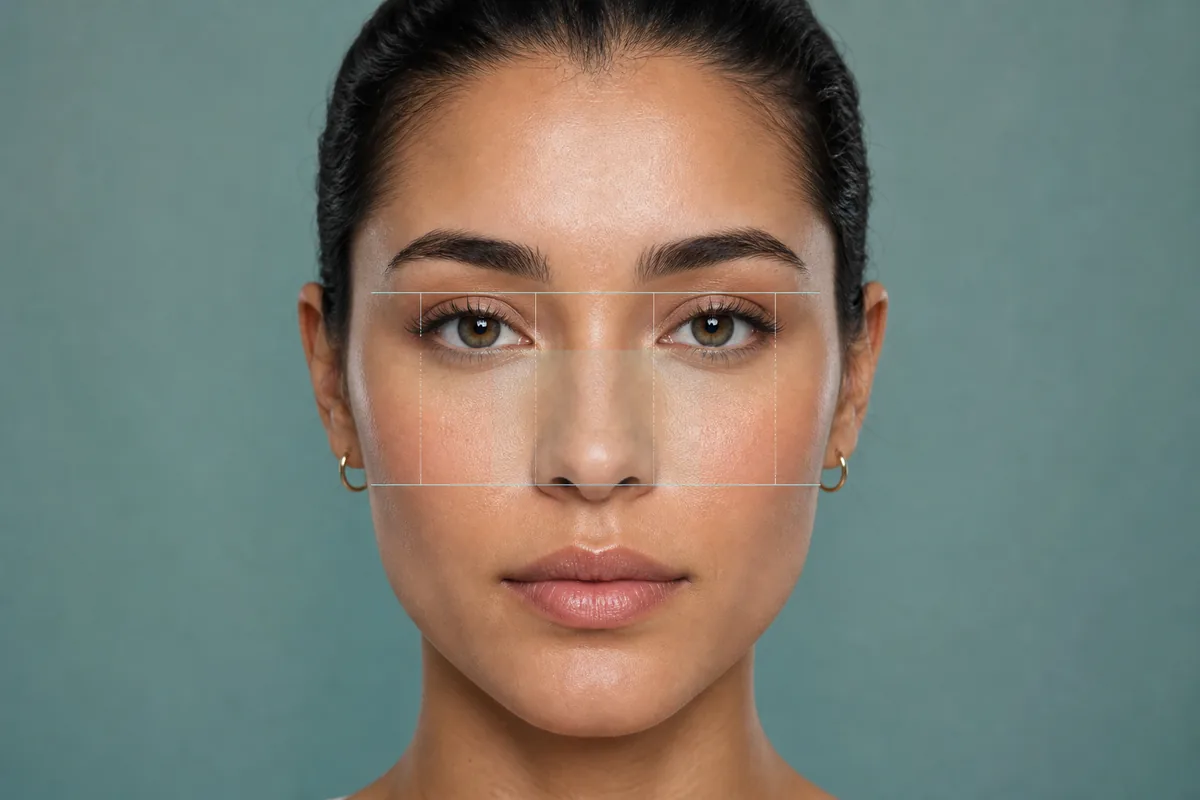
Midface ratio is a common search term, but it does not point to one universal formula. In some contexts it means the height of the middle facial third, usually measured from the glabella or nasion area to the subnasale and interpreted alongside the upper and lower thirds. In other online discussions, mid face ratio is used more loosely for a photo-based distance across the brow, eye-line, nose, or upper-lip region.
That difference is the main reason people get conflicting answers. Two websites can both claim to measure midface length while using different landmarks, different cropping, and different assumptions about head position. The result is not necessarily wrong, but it may be answering a different question.
This guide focuses only on the middle facial region and the conventions used to measure it. For full-face thirds, read /blog/facial-thirds-guide/. For broader proportion context, read /blog/facial-proportions-guide/. If you want to compare adjacent ideas, our /face-symmetry-test/ and /golden-ratio-face-calculator/ can help, but this page stays centered on definition, workflow, and interpretation.
What Is Midface Ratio?
Midface ratio usually refers to the visible height of the middle facial region, but the exact meaning depends on the convention being used. In more structured facial analysis, the midface is often the middle third: a vertical segment from the glabella or nasion area down to the subnasale, which is the point where the base of the nose meets the upper lip. That reading is most useful when compared beside the upper and lower facial thirds rather than treated as a standalone beauty score.
Online, the phrase is often used in a less standardized way. Some creators or tools compare a brow-to-nose zone, some use an eye-line-to-upper-lip span, and some discuss a long or short midface based on appearance rather than strict landmarks. This is why asking what is midface ratio matters before trusting any number.
A careful guide also needs to set limits. Midface ratio is a descriptive proportion cue, not a diagnosis, not a health marker, and not a rule that determines attractiveness. Natural variation across age, sex, ancestry or population background, and soft-tissue presentation all affect how the middle face looks.
Key takeaway
There is no single universal midface ratio formula. The number only makes sense when you know which landmarks and convention were used.
How to Measure Midface Ratio in a Useful Way
If your goal is to understand how to measure midface ratio from a photo, start by choosing a convention before you open any tool. The two most common approaches are a facial-third measurement and a looser internet photo shorthand. Mixing them leads to confusion because they are not interchangeable.
The most stable workflow is to use a straight, front-facing photo with a neutral expression, then mark landmarks and measure in pixels consistently within that same image. You do not need a ruler on the screen. You do need consistent points, camera setup, and enough caution to repeat the check on a second photo.
| Convention | Typical landmarks | Best use |
|---|---|---|
| Facial-third midface height | Glabella or nasion area to subnasale | Comparing the middle face with upper and lower thirds in a more structured proportion check |
| Internet or photo shorthand | Often brow-to-nose, eye-line-to-upper-lip, or similar central-face span | Rough visual comparison inside one creator's or one tool's own system |
| Unlabeled online score | Varies by site and may not be disclosed clearly | Low-confidence reference unless the tool explains its landmarks |
- Choose one convention and stay with it for the full comparison.
- Use a neutral expression, eye-level camera, and consistent distance or zoom.
- Mark landmarks first, then measure in pixels inside the same image.
- Repeat the process on at least two photos before drawing conclusions.
What a Midface Ratio Result Actually Means
A midface ratio result describes how the middle facial region reads under the chosen landmarks in the current photo. It does not tell you whether a face is attractive, healthy, masculine, feminine, youthful, or superior. It is simply a proportion observation tied to method and image conditions.
In the facial-third convention, a longer or shorter middle third may help explain why one portrait feels more vertically stretched or compact. In the internet shorthand convention, the result is even more dependent on the exact landmark choices, so comparison only makes sense within the same tool or repeated manual workflow.
This is also the place to avoid overinterpretation. Online beauty content often treats a long or short midface as a verdict. That is not evidence-based. Faces can be distinctive, balanced, and attractive across a wide range of natural proportions.
Start with the convention
Ask what the tool is measuring before you ask whether your number is high or low.
Read the image, not just the score
A midface reading is useful when it explains something visible in the photo, such as vertical balance or why one angle looks different from another.
Compare like with like
Only compare results taken with the same landmarks, similar framing, and similar head position.
Avoid beauty determinism
A proportion number does not define worth, attractiveness, ethnicity, or health status.
Midface Ratio vs Facial Thirds, Symmetry, and Golden Ratio
Midface ratio overlaps with several other face-analysis ideas, which is why many readers end up on the wrong page. A full facial thirds assessment looks at upper, middle, and lower facial height together. Midface ratio focuses only on the middle region. A symmetry test checks left-right alignment, while a golden ratio tool compares several proportion relationships at once.
Keeping those boundaries clear helps you use the right tool for the right question. If you want a full vertical-balance framework, the better reference is /blog/facial-thirds-guide/. If you want a broader map of measurements, use /blog/facial-proportions-guide/. If you want an adjacent photo-based check, /face-symmetry-test/ and /golden-ratio-face-calculator/ are the natural next steps.
Midface ratio
Best for discussing the height or apparent length of the middle facial region under a named convention.
Facial thirds
Best for comparing the middle face with the upper and lower thirds in a full vertical-balance framework.
Face symmetry
Best for checking whether visible features line up evenly across the facial midline.
Golden ratio
Best for comparing several facial proportions at once rather than isolating only the midface.
Why a Midface Ratio Reading Changes from Photo to Photo
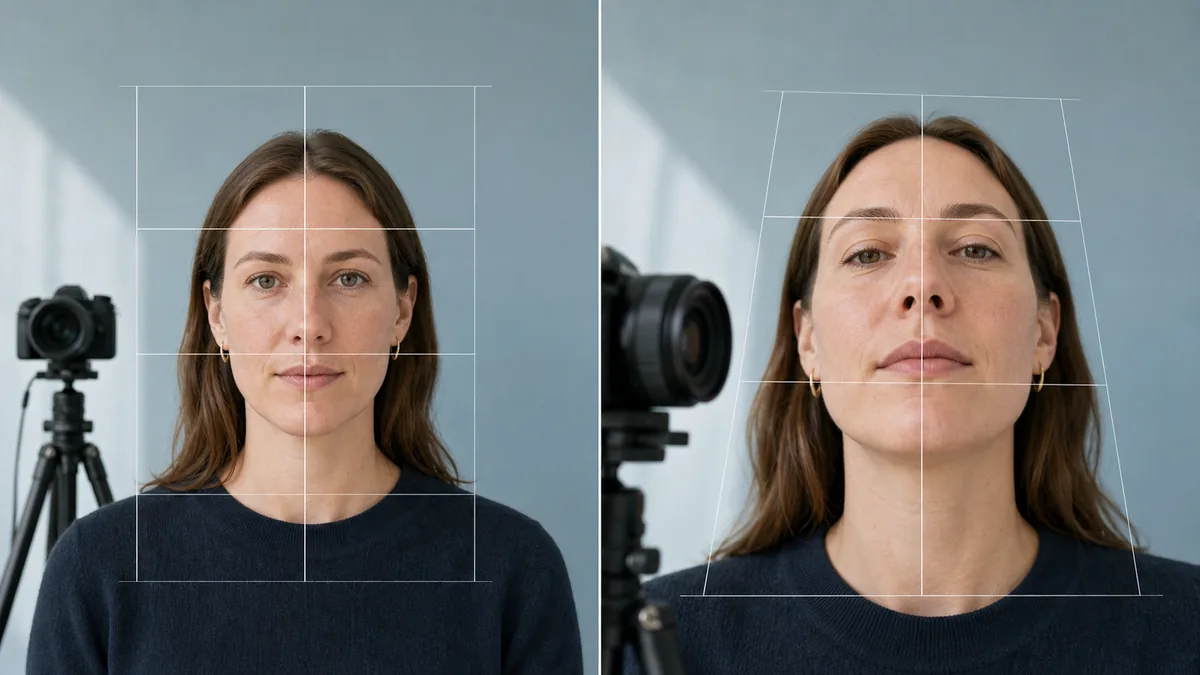
The most common source of confusion is that the same person can get different midface ratio readings from different photos. That is normal. Photo-based measurement is sensitive to perspective, lens distance, head pitch, slight tilt, facial expression, and how clearly landmarks are visible.
A phone selfie taken close to the face can enlarge the center face and shift apparent distances. Raising or lowering the chin changes how long the midface looks. Smiling can alter the upper-lip region and soft tissue. Hairline visibility matters when people drift into a thirds framework without realizing it. Even when bone structure is unchanged, the photo result can move noticeably.
Landmark choice also matters more than many tools admit. One method may start higher near glabella or nasion, another may estimate from the brow region, and another may stop lower or higher around the upper lip. That is enough to produce conflicting outputs without anyone making a math error.
Do not over-read one image
One selfie is not a reliable basis for a permanent statement about your midface length or facial proportions.
Common reasons online midface ratios differ
- Perspective and camera-to-face distance
- Wide-angle selfie lenses and inconsistent zoom
- Head pitch, tilt, or slight rotation
- Expression, lip posture, and soft-tissue change
- Age, sex, ancestry or population background, and landmark selection
For broader context on facial soft tissue and proportion measurement, see this National Library of Medicine review and treat online tools as educational references, not clinical assessments.
How to Use a Midface Ratio Result Well
The best use of midface ratio is practical and limited. It can help you compare photos, understand why one camera setup makes the center face look longer, or see how a tool is defining the middle region. It becomes less useful when it turns into score chasing or a rigid attractiveness ranking.
A better approach is to use the result as one clue among several. If you want more context, compare it with our /face-symmetry-test/ or /golden-ratio-face-calculator/, then check whether the overall picture stays consistent. For full-face vertical proportions, move to /blog/facial-thirds-guide/. For wider proportion concepts, use /blog/facial-proportions-guide/.
One health note matters here: sudden facial drooping or weakness is not a proportion issue. It needs urgent medical evaluation. The National Institute of Neurological Disorders and Stroke provides a clear overview of stroke warning signs.
- Use the same landmarks every time you measure.
- Repeat the check on two clean photos before interpreting the result.
- Do not treat a long or short midface label as a diagnosis or beauty verdict.
- Be cautious about claims that one ideal ratio defines attractiveness for everyone.
If you want to compare this measurement with a broader ratio workflow, start with our golden ratio face calculator.
If you need urgent health context for sudden facial drooping or weakness, read the NINDS stroke signs and symptoms page because that situation is medical, not cosmetic or proportional.
Photo Tips for a More Reliable Midface Ratio Check
Because search intent here is strongly practical, the most useful section is a simple measurement workflow. The goal is not perfect laboratory precision. The goal is a cleaner, repeatable photo process that reduces avoidable noise.
| Do this | Why it helps |
|---|---|
| Use a neutral expression | Smiling, lip tension, or raised brows can move soft tissue and alter landmarks |
| Keep the camera at eye level | Reduces distortion from looking up or down at the face |
| Use consistent distance or zoom | Helps keep perspective changes from altering midface length |
| Avoid tilt or rotation | Keeps the vertical measurement path more stable |
| Mark landmarks before measuring | Prevents guessing and keeps pixel measurements consistent |
| Repeat on a second photo | Shows whether the result is a stable pattern or just a one-photo artifact |
A Careful Step-by-Step Photo Workflow
If you want a DIY answer to how to measure midface ratio, use the same workflow each time. Start with a straight portrait, neutral expression, and even light. Keep the camera at eye level, avoid obvious selfie distortion, and use the same zoom or distance if you are comparing two images.
Next, choose your landmarks. For a facial-third style check, mark the glabella or nasion area and the subnasale. For an internet shorthand check, define the exact brow, eye-line, nose, or upper-lip points you plan to use and do not change them mid-comparison. Then measure in pixels inside the same image, not across different crops with different scaling.
Finally, repeat the process on a second photo and compare the pattern rather than a single number. If the reading shifts a lot, the likely cause is setup, perspective, or landmark inconsistency rather than a real change in anatomy.
Neutral setup
Use a relaxed face, eye-level camera, and stable framing before you measure anything.
Consistent landmarks
Define the exact start and end points first, especially if you are using a nonstandard internet shorthand.
Pixel consistency
Measure within one image using the same unit and the same crop logic throughout.
Two-photo check
A reading repeated across two similar photos is more trustworthy than one isolated result.
Bottom Line
Midface ratio is worth understanding because it shows how the middle facial region is being measured and why online results can conflict. The key is that there are at least two common conventions: a more structured middle-third measurement and a looser internet photo shorthand. Without that distinction, the number is easy to misread.
Use midface ratio as a descriptive photo-based proportion cue, not as a universal formula or a judgment about attractiveness. If you want stronger context, compare the result with facial thirds, symmetry, and broader proportion tools rather than treating one ratio as the final answer.
Practical conclusion
Before asking whether your midface ratio is good, make sure you know which convention was used, measure from clean photos, and interpret the result with restraint.
Midface Ratio FAQ
References and Further Reading
Compare Midface Ratio With Related Face Tools
Use our golden ratio face calculator or face symmetry test if you want to place a midface reading inside a broader photo-based proportion check.