Facial Proportions Guide: How to Read Face Balance
A practical guide to facial proportion analysis, face proportions diagrams, thirds, fifths, feature spacing, symmetry, and balanced photo interpretation.
Quick answer
Facial proportions are the visible relationships between face height, face width, feature spacing, thirds, fifths, and symmetry. They are useful for reading photo balance, styling, and AI analysis output, but they are not a universal beauty law or medical assessment.
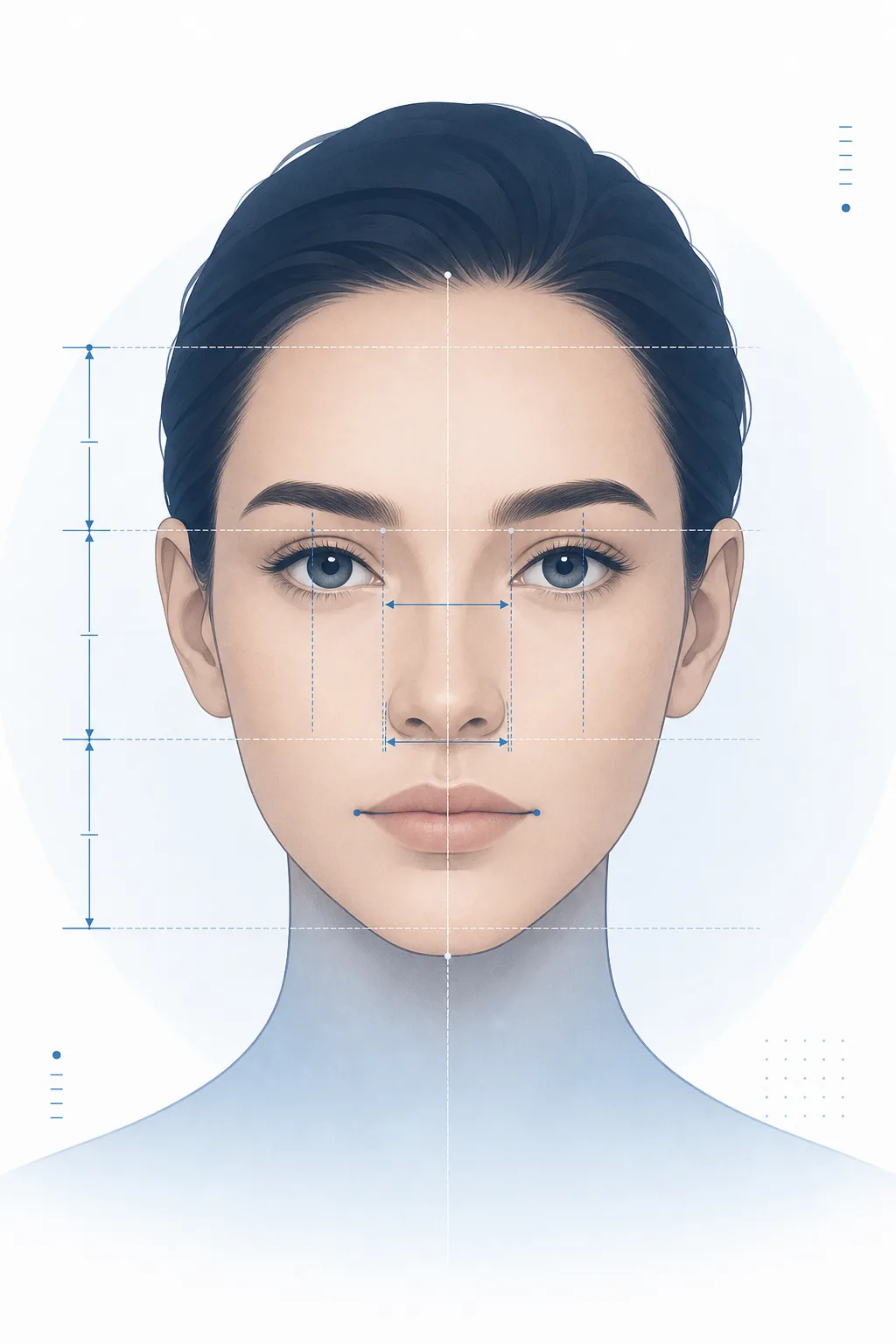
Facial proportions describe the visible size and spacing relationships between parts of the face. This guide connects face proportions, facial thirds, facial fifths, diagrams, symmetry, and photo-based results into one readable framework.
This guide separates those pieces. It explains what each proportion cue actually describes, how an AI face analyzer may use it, and why one photo can make the same face look more or less balanced. The goal is practical interpretation, not a promise that one mathematical pattern defines attractiveness.
If you have already used a face symmetry test or golden ratio face calculator, use this page as the map that connects those smaller signals into one readable face-balance framework.
What Are Facial Proportions?
Facial proportions describe how visible parts of a face relate to one another in a photo. Common examples include face length compared with face width, the balance between the upper, middle, and lower face, eye spacing, and the relationship between the nose, lips, jaw, and outline.
A useful proportion reading starts with measurable structure. It does not need to decide whether a person is beautiful. It can simply explain why a portrait feels vertically balanced, horizontally wide, compact, soft, angular, symmetrical, or visually weighted toward one area.
In AI face analysis, these cues are often calculated from facial landmarks. The system detects points around the eyes, brows, nose, lips, chin, jawline, and contour, then compares distances and angles. The output may become a facial harmony note, a golden ratio score, or a feature breakdown.
Key takeaway
Facial proportions are a reading framework for visible balance. They are useful when interpreted as photo-based cues, not as a permanent verdict on a face.
The Main Facial Proportion Signals
A facial proportions diagram is useful when it labels the landmarks behind a result. Instead of treating one score as a verdict, read each signal separately: width-to-length balance, thirds, fifths, feature spacing, symmetry, and photo distortion.
The table below summarizes the proportion cues that matter most for face-analysis readers.
| Signal | What it describes | How to use it |
|---|---|---|
| Facial thirds | Vertical balance between upper, middle, and lower face | Useful for hairstyle, framing, and understanding why one portrait feels top-heavy or bottom-heavy |
| Facial fifths | Horizontal spacing across the face, often using eye-width style references | Useful for reading eye spacing and face width, but sensitive to angle and lens distortion |
| Face width-to-length ratio | How broad or long the face appears | Useful for face shape context and camera-distance checks |
| Feature spacing | Distance relationships among eyes, nose, lips, brows, and jaw | Useful when a report explains balance instead of only giving a beauty score |
| Symmetry | Left-right alignment and visual balance | Useful as one cue, but not the same as proportion or attractiveness |
| Golden ratio context | Multiple proportion comparisons against selected ratios | Useful as a structured reference, not as a universal rule |
Facial Thirds vs Facial Fifths: What Each Diagram Shows
Facial thirds and facial fifths are often mentioned together, but they answer different questions. Thirds are a vertical framework: they compare the upper, middle, and lower face. Fifths are a horizontal framework: they divide the face width into five approximate columns and are often used to discuss eye spacing and feature width.
Neither framework is a pass-or-fail test. A face can have balanced thirds but still appear wider because of lens distance. Another face can have close eye spacing in one selfie and a more neutral reading in a straight portrait. These frameworks are most useful when they explain the current image, not when they are treated as fixed identity labels.
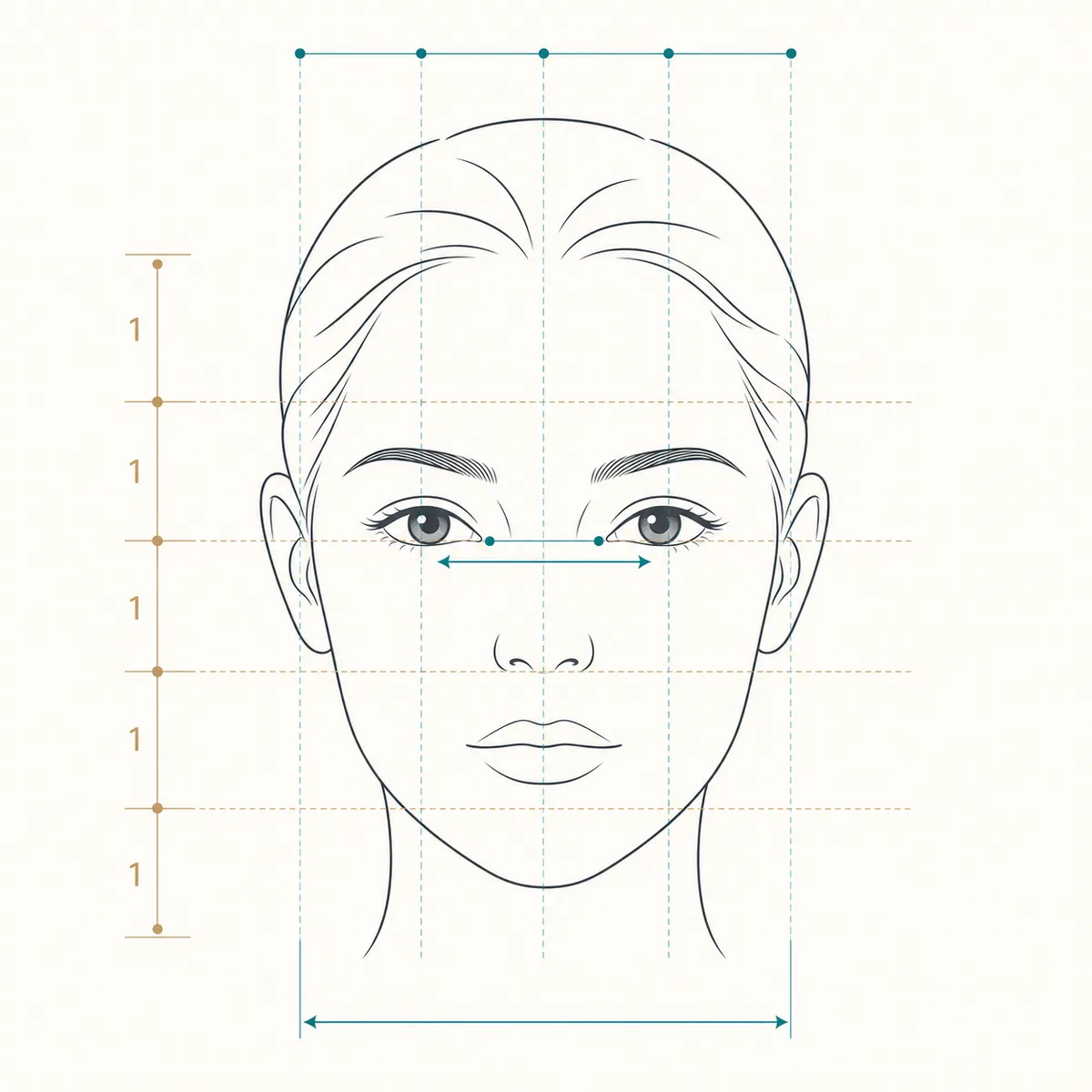
Use thirds for vertical balance
Ask whether the forehead, midface, and lower face read proportionally in the image.
Use fifths for horizontal spacing
Ask whether eye spacing, face width, and central features look compressed or spread out.
Read both with photo context
Camera distance, tilt, expression, hairline, and facial hair can change both readings.
Avoid one-number conclusions
A proportion cue becomes useful when it explains the photo, not when it becomes a beauty verdict.
Are There Perfect Face Proportions?
Search results often use phrases like perfect face proportions or ideal facial proportions, but those phrases need caution. Proportion references can describe patterns that many people find balanced, yet they cannot capture expression, movement, personality, culture, styling, or the way a face feels in real life.
A better question is: which proportions are helping or confusing this specific photo? For example, a close selfie can enlarge the nose and midface. A high camera angle can shorten the lower face. A smile can change mouth width and cheek volume. A hairstyle can make the upper third look shorter or longer.
That is why FaceAnalysis.org treats proportion results as explanatory cues. They can support styling and photo feedback, but they should not be used for medical, dental, legal, hiring, identity, or other high-stakes decisions.
Safety note
This article is educational and cosmetic in scope. It does not diagnose facial structure, dental alignment, health conditions, age, identity, or suitability for any professional decision.
How to Check Facial Proportions More Fairly
A proportion reading is only as stable as the photo. If the image is tilted, too close, filtered, partly covered, or strongly shadowed, the result may describe the photo setup more than the face itself.
For a useful comparison, take a straight portrait first. Then compare other photos against that baseline instead of assuming every result should match exactly.
- Use a front-facing portrait with both ears or both sides of the jaw roughly visible.
- Keep the camera near eye level and avoid very close wide-angle selfies.
- Use neutral lighting so shadows do not change the apparent nose, brow, or jaw width.
- Keep expression relaxed if you want stable lower-face and mouth-width cues.
- Compare several photos before drawing conclusions from one score.
How AI Face Analysis Reads Proportions
An AI face analyzer usually begins with face detection and landmark mapping. Once landmarks are placed, the system can estimate distances, angles, and relative positions. Those measurements may be converted into face shape labels, symmetry scores, golden ratio references, or descriptive notes about facial harmony.
The strongest outputs stay close to visible evidence: eye spacing, face width, thirds, jawline outline, and image quality. The weakest outputs are vague judgments that do not explain what was measured. When you read a report, look for the visual reason behind the score.
This is also why two tools can disagree. They may use different landmarks, different face crops, different thresholds, or different weighting between symmetry, proportions, and aesthetic labels. Disagreement does not always mean one tool is broken; it often means the tools are answering slightly different questions.
How to Use Facial Proportion Results Well
The best use of facial proportion analysis is practical. You can use it to understand why one profile photo feels more balanced, why a haircut changes face shape, why glasses alter feature spacing, or why one camera angle makes the lower face look stronger.
Do not chase a mythical perfect layout. Instead, combine proportion results with adjacent signals: symmetry for left-right balance, face shape for styling context, golden ratio for multi-measure comparison, and the broader face analysis guide for privacy and accuracy limits.
For styling
Use proportion notes to compare hair volume, beard lines, glasses width, and photo framing.
For photos
Use the result to choose camera distance, head angle, lighting, and crop more intentionally.
For AI reports
Look for explanations that name the signal, not just a beauty score.
For confidence
Treat the result as feedback about an image, not a final statement about you.
Facial Proportions FAQ
References and Further Reading
Try Face Proportions in a Live Tool
Use FaceAnalysis.org to compare proportion notes with symmetry, golden ratio, face shape, and photo quality signals from one portrait.