How a Facial Symmetry Test Works: What It Measures and Misses
A practical guide to left-right facial balance, landmark measurements, photo distortion, AI estimates, and the limits of a symmetry score.
Written by
FaceAnalysis.org Editorial Team
AI face analysis and visual measurement editors
We explain photo-based face analysis in plain language, with practical checks for measurement limits, privacy, and responsible interpretation.
Editorial review
Reviewed on 2026-10-09 for facial symmetry terminology, photo limitations, and clear separation between appearance feedback and medical questions.
Facial symmetry is a visual description of one image, not a medical diagnosis or a fixed measure of attractiveness.
How this guide was prepared
The guide combines the site's face-analysis workflow with a measurement-first explanation of facial landmarks. The goal is a repeatable visual check, not a diagnosis or a permanent rating.
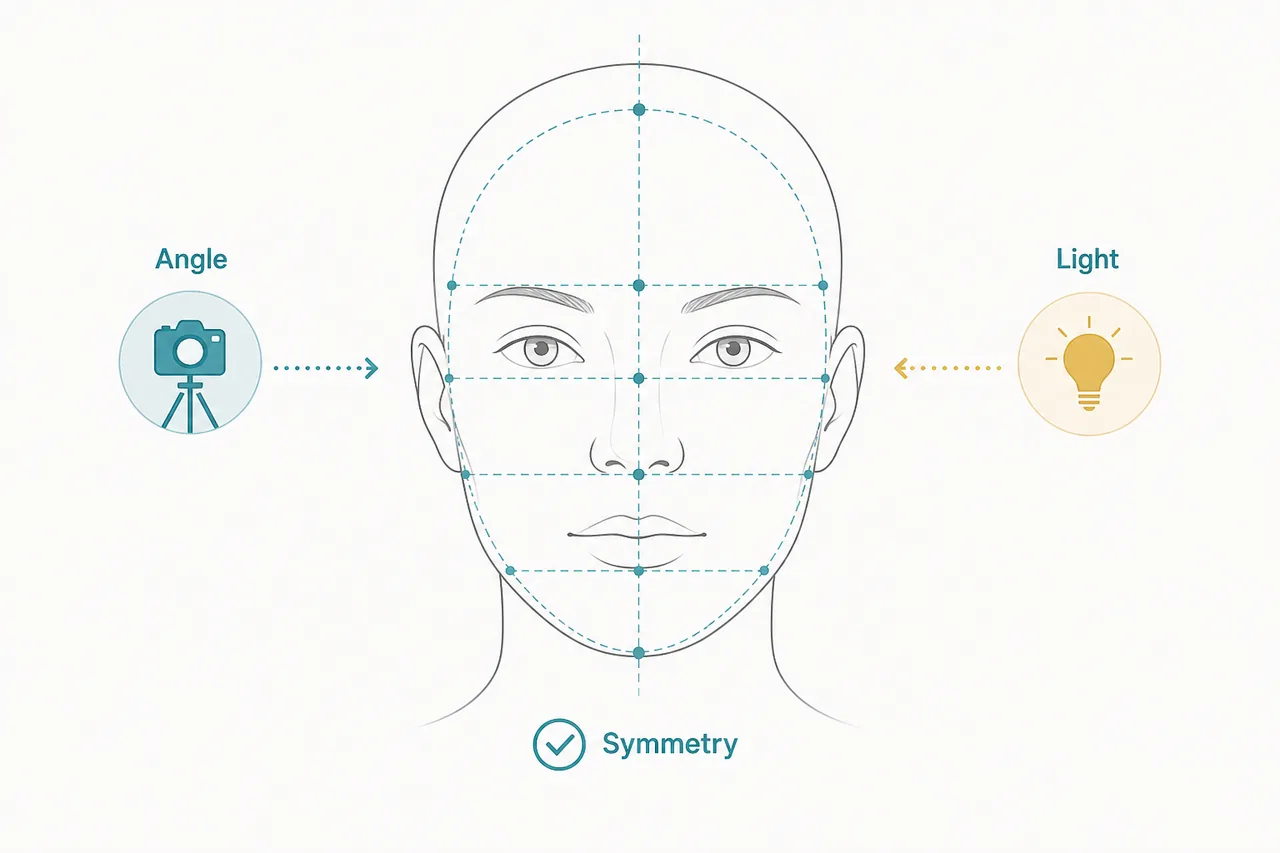
A facial symmetry test is a structured comparison of the left and right sides of a face in one image. It may compare eye height, brow position, nose alignment, mouth corners, cheek width, and the outline of the jaw. The result is usually a visual balance estimate, not a statement about identity, health, or human worth.
The useful question is not whether a face is perfectly mirrored. Perfect bilateral symmetry is uncommon, and a camera can make a small difference look much larger. A good test explains which landmarks were compared, how the photo was prepared, and why the number should be read as a range of visual feedback.
What Does a Facial Symmetry Test Measure?
Facial symmetry describes how closely the visible arrangement on one side resembles the other around a center line. A test does not compare two identical halves because real faces contain small differences in bone, soft tissue, expression, and growth. Instead, it chooses landmarks and measures their relative position, angle, or distance from the center.
Common landmarks include the inner and outer corners of the eyes, eyebrow height, the bridge and tip of the nose, the corners of the mouth, cheek edges, chin center, and jawline points. Some tests produce one overall percentage; others show separate eye, nose, mouth, and lower-face signals. The labels vary, so the method behind the result matters more than the decimal.
Quick answer
A facial symmetry test compares selected left-right landmarks in a photo. It estimates visible balance; it does not diagnose a condition or define attractiveness.
Signals Used in a Symmetry Test
Different tools use different landmark sets, but the same basic signals appear again and again. Reading them separately helps you understand why two tools can return different scores from the same selfie.
| Signal | What is compared | Why it can change |
|---|---|---|
| Eye level | Height and angle of the two eyes | Head tilt, expression, and lens angle |
| Brows | Arch, height, and distance from the center line | One raised brow or uneven light |
| Nose | Bridge, tip, and nostril alignment | Close camera perspective and turn of the head |
| Mouth | Corner position and lip line | Smile, speech, tension, or a relaxed expression |
| Cheeks and jaw | Outer width, chin center, and jaw direction | Hair, shadow, posture, and three-quarter angle |
- Look for the center line before judging a single feature.
- Treat a component score as context, not a ranking of your face.
- Compare results only when the photos use a similar distance, crop, and expression.
- Keep the tool's definition of symmetry separate from facial proportions or a beauty score.
How a Facial Symmetry Test Works Step by Step
A photo-based test normally follows a short pipeline. The exact code is not always public, but the visible stages are easy to understand: accept a face image, locate landmarks, establish a center reference, compare left and right signals, and explain the result.
1. Find the face
The tool checks that a face is visible and identifies a usable front-facing region. Hair, hands, heavy shadows, or more than one face can reduce confidence.
2. Place landmarks
It estimates points around the eyes, brows, nose, lips, chin, cheeks, and jaw. These points are the basis for every later comparison.
3. Set a reference
A vertical center line or normalized face box gives the tool a common frame for left-right distances and angles.
4. Compare signals
The system calculates differences between paired landmarks or mirrored regions and may report component values.
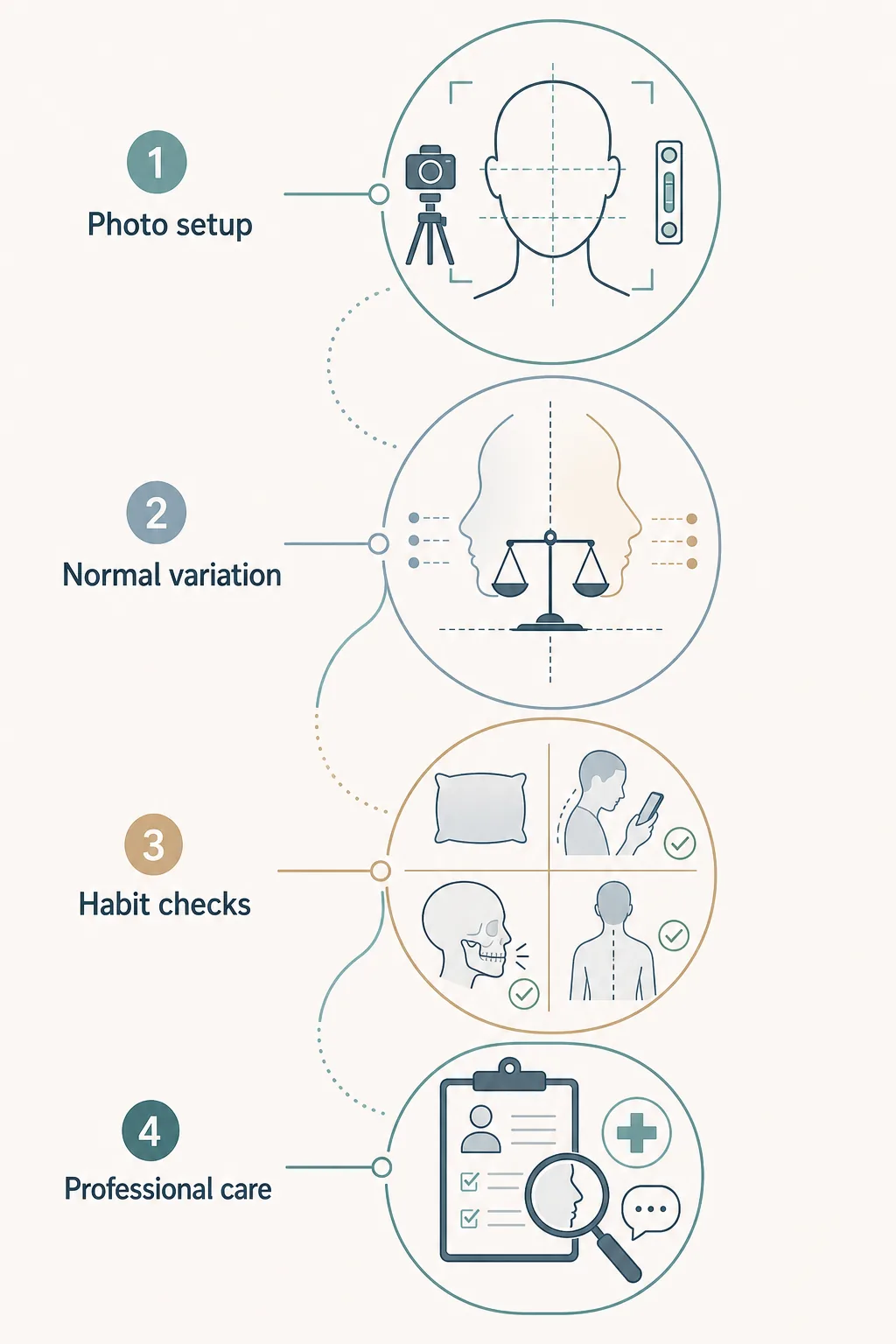
How to Read the Result Without Overreading It
A symmetry score is easiest to use when you treat it as a measurement of one image. It is not a universal rating of a person, and it should not be compared with a friend's score as if the two photos were laboratory samples. Look for the explanation, the component pattern, and whether the result is stable when the setup is repeated.
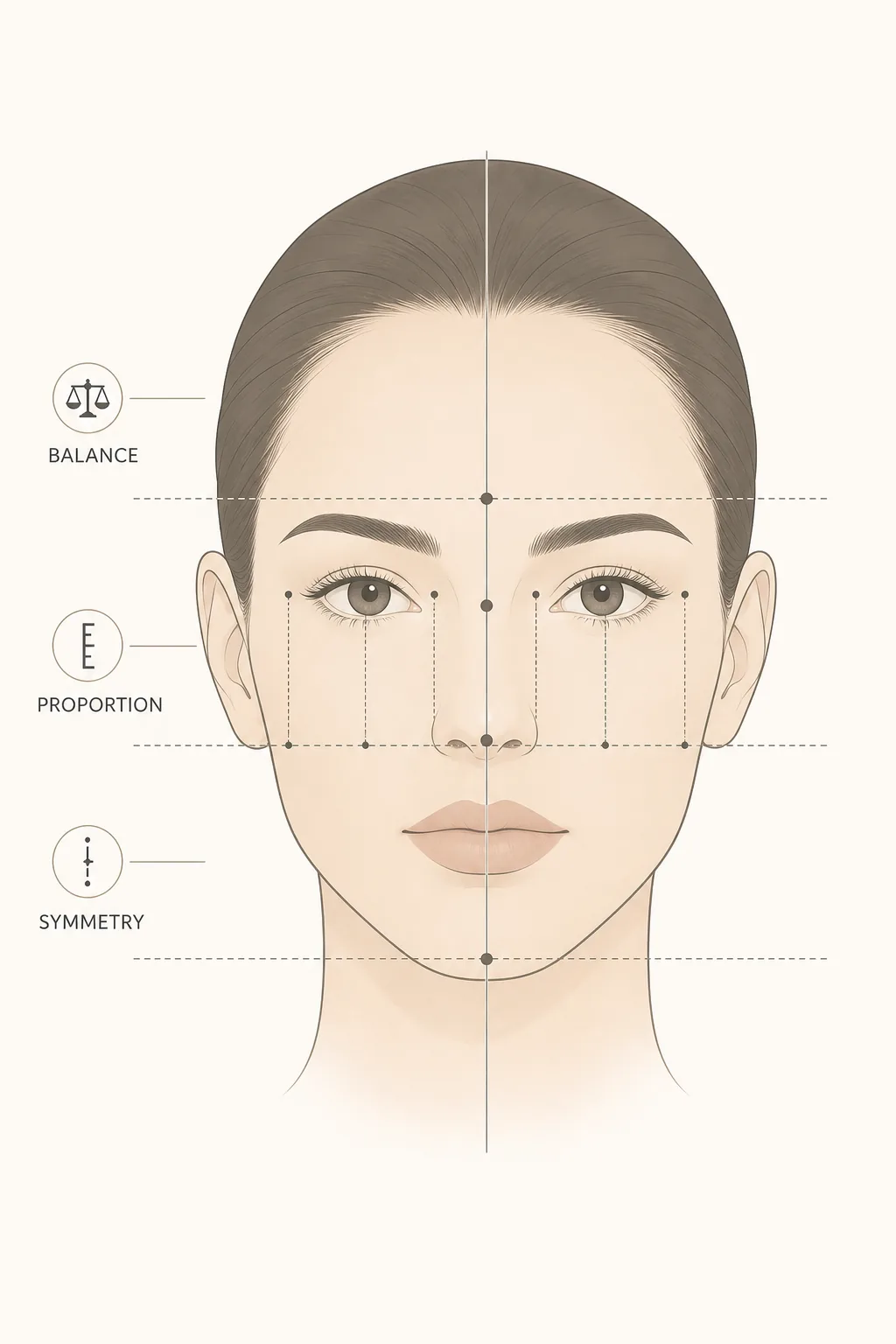
Symmetry
Are paired left-right landmarks visually aligned in this photo?
Proportion
How do distances such as face length, width, or thirds relate to one another?
Harmony
How do several visible features read together as a balanced portrait?
Face shape
What broad outer contour best describes the forehead, cheeks, and jaw?
Expression
Did a smile, blink, or raised brow change the apparent balance?
Why Photos Change a Symmetry Score
A photo changes the input before a test has a chance to compare landmarks. A phone held too close can enlarge the center of the face, while a small turn can make one cheek or eye look farther away. Expression, lighting, hair, glasses, and crop add more variation.
Use the score as a photo signal, not a judgment
Use the score as feedback about a photo. It is not a judgment of a person, a diagnosis, or a universal beauty scale.
What improves a visual comparison
- Pull hair away from the eyes, cheeks, and jaw.
- Use even front light and avoid a hard shadow on one side.
- Keep the camera near eye level and step back from a wide-angle selfie.
- Use a neutral expression before testing a smiling photo.
For background on facial asymmetry and its many possible causes, see the facial asymmetry review . It is useful context, not a formula for scoring a selfie.
Using an AI Symmetry Test Responsibly
An AI symmetry test can estimate visible landmarks from the image you provide. It cannot see your full range of expressions, your history, or a hidden medical cause. A responsible page states what the image is used for and keeps the result proportional to that narrow input.
- Upload only a photo you have permission to use.
- Read the service's privacy explanation before sending a face image.
- Avoid using an ID photo, work badge, or another person's portrait.
Read our Privacy Policy.
For broader consumer guidance, see the FTC biometric information overview .
A Repeatable Workflow for a Fair Test
You do not need special equipment. A timer, a stable phone position, soft light, and a neutral expression are enough to create a more comparable input. The aim is not to make the face look perfect; it is to reduce avoidable variation so the same landmarks are measured in a similar way.
| Step | What to do | Why it helps |
|---|---|---|
| 1. Clear the outline | Move hair and glasses away from key landmarks | Keeps the contour and eye line visible |
| 2. Level the camera | Place the lens at eye height | Reduces apparent jaw and brow tilt |
| 3. Step back | Use a natural portrait distance and crop later | Limits wide-angle enlargement |
| 4. Relax | Take a neutral face before a smiling version | Separates structure from expression |
| 5. Repeat | Take two or three photos with the same setup | Shows whether a score is stable |
What the Test Can and Cannot Tell You
The result can describe visible alignment in a particular portrait and help you compare camera distance, framing, or expression. It is most useful when the tool explains its landmarks and the input is clear enough to support them.
It can
Describe visible alignment in a particular photo and suggest which landmarks changed.
It can
Help you compare camera setup, expression, or framing choices.
It cannot
Diagnose dental, jaw, nerve, skin, or other medical conditions.
It cannot
Prove that one face is more valuable, attractive, or correct than another.
Summary: Understand the Measurement Before the Number
A facial symmetry test is a landmark comparison around a center line. It can be useful for checking a portrait, but the score depends on the photo, the selected landmarks, and the tool's weighting rules. Compare like with like, read component explanations, and keep symmetry separate from proportion, harmony, and face shape.
The most responsible workflow is simple: use a clear front-facing photo, repeat the setup once, treat the result as visual feedback, and seek qualified help for sudden changes, pain, weakness, or other symptoms instead of relying on an appearance tool.
The short answer
Facial symmetry tests measure visible left-right landmark differences in a photo. They are useful for comparison and curiosity, but they are not diagnoses or permanent judgments.
Facial Symmetry Test FAQ
References and Further Reading
Want to Compare Your Photo?
Use a clear front-facing photo in the Face Symmetry Test, then return to this guide to understand which signals may have affected the result.