Facial Analysis vs Facial Recognition: What Each Does
A plain-language comparison of appearance analysis, face matching, common terms, outputs, and practical privacy checks.
Quick answer
Facial analysis vs facial recognition is mainly a difference in purpose. Facial analysis describes or measures visible features in an image; facial recognition compares a face with a reference to check or infer identity. The terms can overlap in image processing, so ask what a specific service actually collects, compares, stores, and returns.
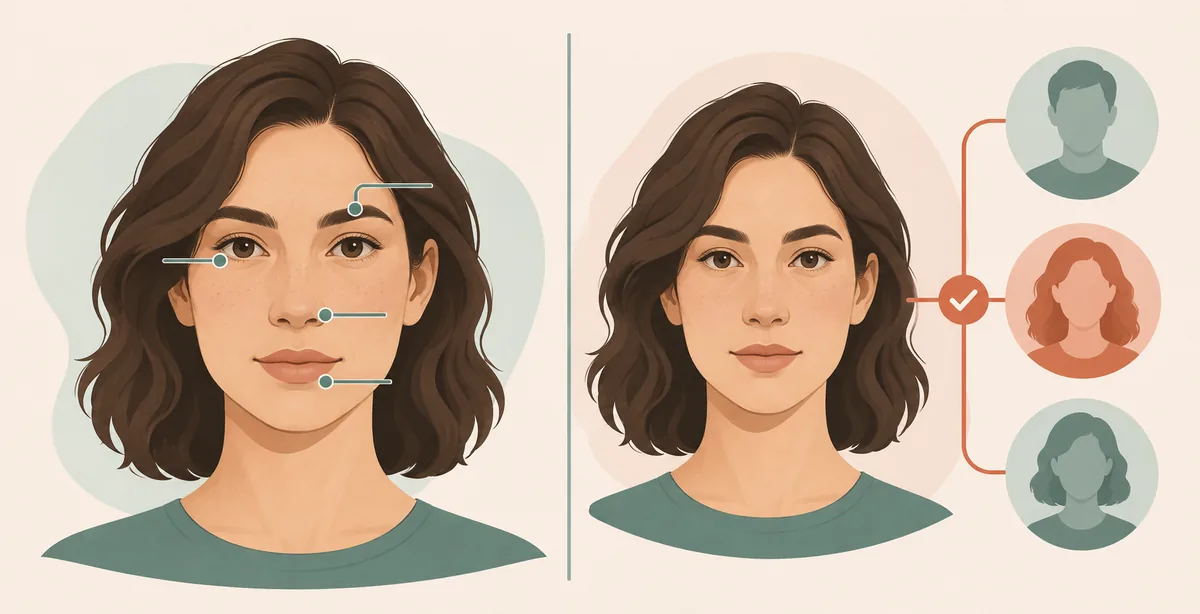
Facial analysis vs facial recognition can sound like two names for the same technology, but they describe different questions. An appearance-focused analysis may describe proportions, landmarks, or other visible cues in one photo. A recognition system asks whether a face matches a reference or appears in a set of references.
The boundary is not always obvious from a product name. Both kinds of software may detect a face, align an image, or create a numerical representation before producing a result. The practical difference is what the service is trying to infer and what it does with the face data.
This guide separates the tasks, explains detection, verification, and identification, and gives you a short privacy checklist.
Facial Analysis vs Facial Recognition: The Short Answer
The difference is the task: facial analysis describes or measures visible cues in an image, while facial recognition compares face information with a reference for an identity-related result. Both can detect and process a face, so a product label alone is not enough. Check what the service returns, what reference it uses, and how it handles the photo or any derived data.
What Facial Analysis Does With a Face Photo
Facial analysis is a broad label for software that examines information visible in a face image. Depending on the product and its stated purpose, it may locate facial landmarks, estimate relative distances, classify an appearance feature, or summarize image characteristics. An appearance tool might describe face shape, feature spacing, symmetry cues, or photo quality without trying to name the person.
The output should be read in relation to the input. A result generated from one selfie is about that image and the system's chosen measurements. Camera distance, head angle, expression, lighting, crop, and image processing can alter what the system sees. A score or label is not automatically a stable fact about a person, and it is not a medical or identity assessment.
What Facial Recognition Tries to Match
Facial recognition generally refers to comparing face information for an identity-related purpose. A system may compare two face samples to evaluate whether they likely belong to the same person, or compare one sample with a collection of references to look for a possible match. The reference can be a previously enrolled photo, an account image, or another face record supplied to the system.
A recognition result is usually a match score, a yes-or-no decision, or a ranked list of possible candidates. It is a system output, not proof by itself. Image quality, camera conditions, thresholds, the reference set, and the decision process all matter. A human or another system may make the final decision, but that does not remove the need to understand how the match was produced.
Where Face Detection, Verification, and Identification Fit
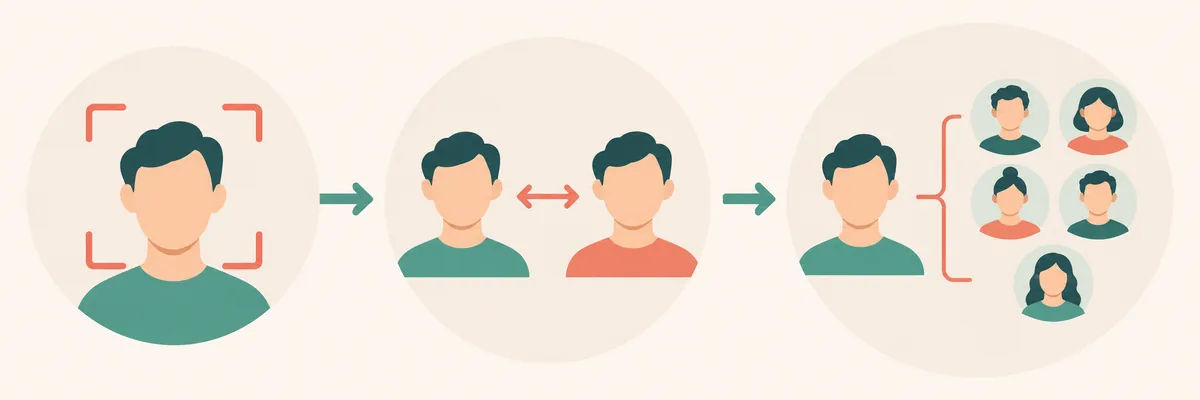
Face detection asks whether a face is present and where it appears in an image. Detection can be an early step in an analysis or recognition pipeline, but finding a face is not the same as identifying who it is. A camera can detect a face without comparing it with any identity record.
Verification is usually a one-to-one comparison: does this sample appear consistent with the reference for a claimed identity? Identification is usually a one-to-many search: does this sample resemble an entry in a collection, and if so, which candidate is closest? Systems differ, and terminology should be checked in the specific product documentation.
Terminology varies
Some documentation uses face matching, face identification, or biometric comparison differently. When the distinction affects your decision, ask the provider to describe the reference set and the exact decision being made.
A Side-by-Side Comparison of Inputs and Outputs
The same image-processing steps can support different tasks. The purpose, reference data, and output show what a system is being asked to do.
| Aspect | Appearance-focused facial analysis | Facial recognition |
|---|---|---|
| Purpose | Describe or measure visible cues | Compare a face with a reference for identity |
| Typical input | One face image may be enough | A sample plus a reference image or gallery |
| Typical output | Feature description, estimate, or image-quality signal | Match score, decision, or candidate list |
| Detection | Locates a face; does not identify the person | Often an early step before comparison |
| Verification | Not necessarily involved | One-to-one check against a claimed identity |
| Identification | Not necessarily involved | One-to-many search through a reference gallery |
How to Tell Which System a Service Uses
Facial analysis vs facial recognition is easier to distinguish when a provider names its output, reference data, retention period, and decision process.
Name the task
Write down whether the service describes visible features, checks a claimed identity, or searches a gallery; read any score as a system output, not a fact.
Follow the data
Check where the photo goes, whether a face template is created, how long each item remains, and who can access it.
Check the decision
For consequential uses, find out what human review, appeal, or alternative is available.
Privacy Questions to Ask Before Sharing a Face Photo
A useful privacy check follows the image through the service. Start with the information available before upload: who operates the tool, why it needs the photo, whether processing is local or server-based, and how long the original image and any derived representation are kept. A short privacy notice is more useful when it answers these questions directly.
- Purpose: is the service describing appearance, verifying an account, or searching for a match?
- Reference data: does it compare the image with a photo, account, or gallery?
- Retention: when are the original image and derived face data deleted?
- Reuse and sharing: can data be used for training, analytics, or third-party processing?
- Control: can you decline, delete stored data, or use the service without an account?
Do not infer privacy from a product category
An appearance-analysis label does not by itself explain storage, reuse, or sharing. Review the service's own privacy information and the choices available to you.
Facial Analysis vs Facial Recognition FAQ
References and Further Reading
Explore Appearance-Focused Face Analysis
See how photo-based face analysis describes visible features, and keep its results separate from identity matching or high-stakes decisions.