What Is My Eye Shape? A Practical Guide to Reading Your Eyes
A calm, photo-friendly way to compare eyelid crease, lid space, eye opening, and outer-corner direction without forcing your eyes into one perfect label.
Written By
Clara Bennett
Beauty-tech columnist and lifestyle features writer
Clara writes about beauty, AI tools, privacy, and digital culture with a focus on practical photo interpretation.
Editorial Standard
Researched and updated on 2026-06-28 using beauty editorial patterns, anatomy-aware terminology, and FaceAnalysis.org photo-analysis guidance.
This article is for styling, makeup, and low-stakes photo interpretation. It is not medical, biometric, or identity advice.
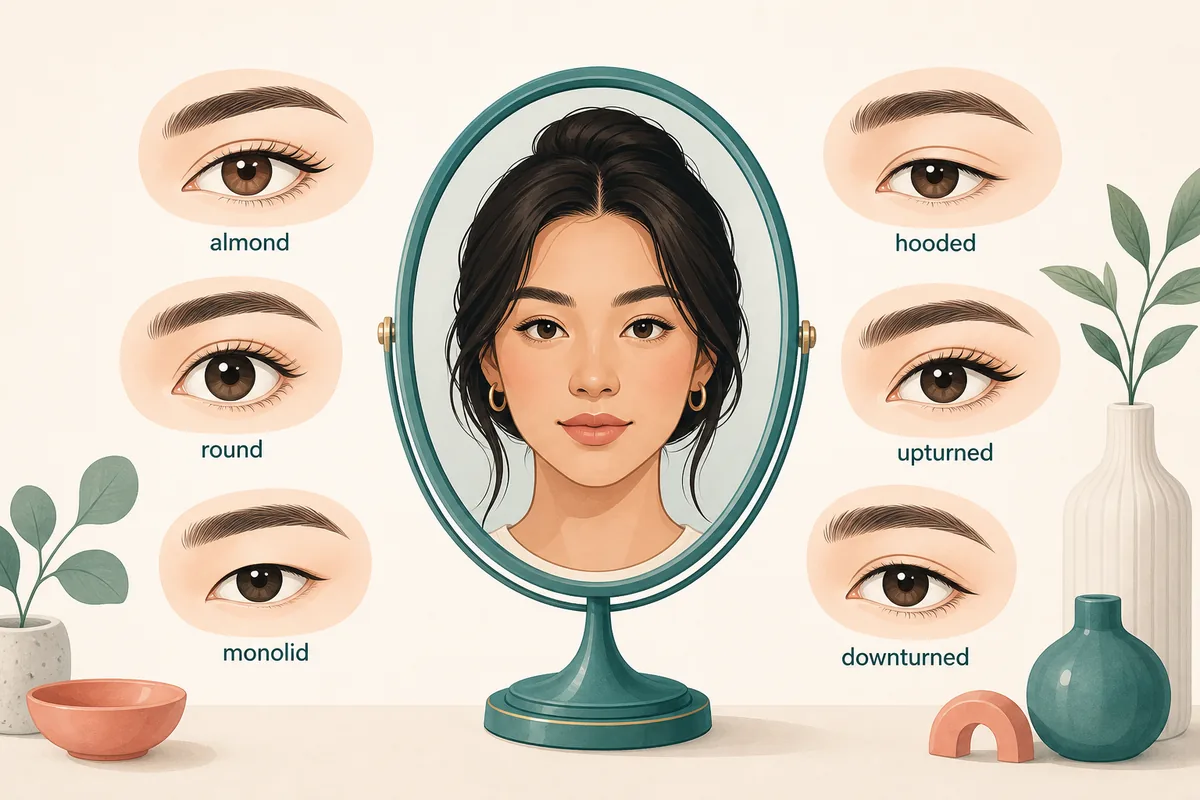
If you have ever searched “what is my eye shape,” you have probably noticed that the answer is rarely as simple as picking one label from a chart. One person may have almond eyes with a slightly hooded lid. Another may have round eyes with subtly downturned outer corners. A third may have monolid eyes that look different in a mirror, a selfie camera, and a side-lit photo.
That is why this guide starts with observable cues instead of beauty labels. You will look at eyelid crease, visible lid space, eye opening, the direction of the outer corners, and how much the iris is covered by the upper and lower lids. Those cues are more useful than trying to match your face to a single celebrity example.
The goal is practical: understand your eye shape well enough to read makeup advice, compare photos, and interpret AI face analysis results without overthinking a single word.
Quick answer
To find your eye shape, look straight into a mirror or clear front-facing photo. Check whether you have a visible crease, how much lid space shows when your eyes are open, whether the iris looks more rounded or tapered, and whether the outer corners sit higher, level, or lower than the inner corners.
The Quick Mirror Method for Finding Your Eye Shape
Use a relaxed expression, natural light, and a straight-on mirror view. Do not raise your brows, squint, smile hard, or tilt your head, because all of those can change crease visibility and corner direction. If you are using a photo, choose one taken at eye level with both eyes visible.
Start by asking four questions. First, is there a visible crease above the lash line? Second, when your eyes are open, does the mobile lid show clearly or mostly disappear under the upper fold? Third, do the outer corners point slightly upward, stay level, or slope downward? Fourth, does the eye opening look round, tapered, narrow, or elongated?
These questions matter because most common eye-shape labels are built from combinations of those cues. Almond eyes are usually tapered at both ends. Round eyes show more circular openness. Hooded eyes have a fold that covers much of the mobile lid. Monolid eyes usually have little or no visible crease. Upturned and downturned eyes are defined by the direction of the outer corners.
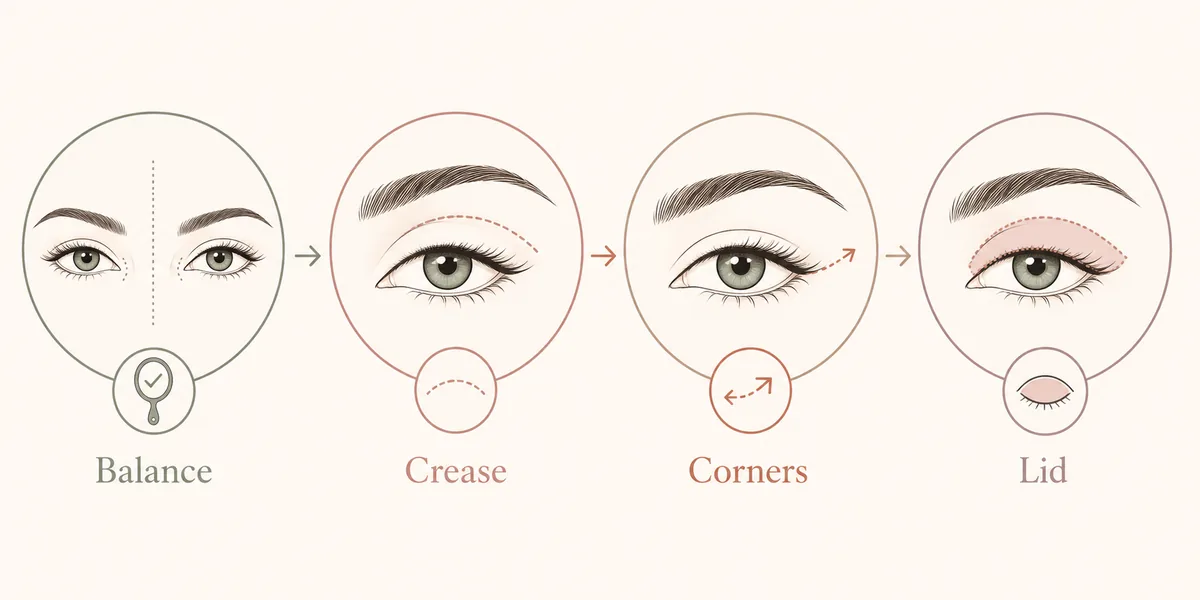
| Cue | What to Look For | Why It Matters |
|---|---|---|
| Crease | A visible fold, hidden fold, or no obvious crease | Separates monolid, hooded, and more open-lid shapes |
| Lid space | How much mobile lid shows when looking straight ahead | Explains why some makeup looks disappear on hooded or deep-set lids |
| Outer corners | Higher, level, or lower than the inner corners | Helps identify upturned, neutral, or downturned tendencies |
| Eye opening | Rounder, narrower, or tapered at both ends | Helps distinguish round, almond, and narrow-set appearances |
Common Eye Shapes and How to Tell Them Apart
The labels below are useful, but they are not fixed identities. Many faces combine two or three cues. Use the descriptions as a reading guide, not as a rulebook.
When in doubt, describe what you actually see: visible crease, low crease, hidden lid, tapered corners, round opening, raised outer corner, or lowered outer corner. That language will help you choose better makeup, glasses, and photo angles even if your final label stays mixed.
Almond eyes
Usually tapered at the inner and outer corners, with the iris partly touched by the upper and lower lids. The shape often looks longer than it is tall.
Round eyes
The eye opening looks more circular, and more of the iris or white area may be visible above or below the iris when the face is relaxed.
Hooded eyes
A fold of skin from the brow area covers part of the mobile lid, so eyeliner or shadow can disappear when the eyes are open.
Monolid eyes
There is little or no visible crease separating the lid from the brow area. Lid space may look smooth rather than folded.
Upturned eyes
The outer corners sit slightly higher than the inner corners, giving the eye a lifted or winged direction even without makeup.
Downturned eyes
The outer corners sit slightly lower than the inner corners, which can create a softer or more relaxed outer-eye direction.
Why Your Eye Shape Can Look Different in Photos
A mirror view and a selfie can disagree because cameras distort proportion, especially at close range. A phone held too low can make the outer corners look heavier. A phone held too high can make the upper lid look more open. Strong side lighting can deepen a crease or hide one side of the lid.
For the most stable read, compare two inputs: a relaxed mirror view and a front-facing photo taken from a normal portrait distance. If both show the same crease and corner pattern, your read is probably stable. If they differ, the photo setup may be changing the appearance more than your actual structure.
This is also why AI face analysis should be read as photo-based feedback. The model can observe visible landmarks and proportions inside one image, but the image itself still carries lighting, angle, expression, lens, and resolution effects.
- Use eye-level camera height for comparison photos.
- Avoid strong upward or downward angles when judging outer corners.
- Keep brows relaxed so the crease is not artificially lifted.
- Take one no-makeup reference photo if makeup changes lid shape or corner emphasis.
What If Your Eyes Fit More Than One Shape?
Mixed eye shapes are normal. You might have almond-hooded eyes, round-upturned eyes, monolid eyes with a lifted outer corner, or downturned eyes with a very visible crease. In real faces, labels overlap because crease structure and corner direction are separate features.
The most useful final answer is often a two-part label. Instead of forcing “almond” or “hooded,” say “slightly hooded almond eyes.” Instead of “round” or “downturned,” say “round eyes with downturned outer corners.” That gives you more accurate styling information.
This approach also keeps the topic emotionally healthier. Eye shape is not a ranking system. It is a description of structure, and every shape can look expressive, balanced, dramatic, soft, or striking depending on the rest of the face and the photo context.
| If You Notice | Try Describing It As | Why It Helps |
|---|---|---|
| Tapered eye plus hidden mobile lid | Hooded almond eyes | Explains both shape and makeup placement |
| Round opening plus lifted outer corner | Round upturned eyes | Separates openness from corner direction |
| No visible crease plus lifted outer corner | Upturned monolid eyes | Keeps monolid structure and direction visible |
| Visible crease plus lowered outer corner | Downturned eyes with a defined crease | Avoids treating corner direction as the whole eye shape |
How AI Face Analysis Can Help with Eye Shape
AI can be useful when it stays close to visible structure. It can help detect eye position, spacing, symmetry, tilt, and relative proportions. That makes it helpful for comparing photos or noticing whether one image makes your eyes look more lifted, round, narrow, or shadowed.
It is less useful when it pretends to give one permanent identity from a single image. A face analyzer is looking at pixels, not your full real-life expression. If the photo is blurred, filtered, shadowed, or angled, the output can shift.
Use AI feedback as a second opinion after your mirror check. If the tool notes eye balance, canthal tilt, or facial symmetry, compare those observations with what you see in the mirror. When both point in the same direction, the result is more useful.
- Use AI to compare photo setups, not to decide your worth.
- Treat eye-shape labels as descriptive, not diagnostic.
- If two clean photos give different reads, inspect lighting and angle before changing your conclusion.
Makeup and Photo Tips by Eye Shape Cue
Once you know the cue that matters most, styling advice becomes easier to filter. A hooded lid usually needs placement above the visible fold. A downturned outer corner may benefit from softly lifted liner. Round eyes can look more elongated with outer-corner depth. Monolid eyes often show gradient placement beautifully because the lid surface is smoother.
The same idea applies to photography. If you want a clearer eye-shape read, avoid harsh overhead shadows and extreme camera distance. If you want a more flattering portrait, experiment with eye-level framing, soft light, and a relaxed gaze before assuming the shape label is the problem.
| Main Cue | Try This | Avoid Overreading |
|---|---|---|
| Hooded lid | Place liner and shadow slightly above the fold | A hidden lid is not the same as small eyes |
| Round opening | Add soft outer depth if you want elongation | Round eyes do not need to be made smaller |
| Monolid | Use gradients and lash definition for dimension | A crease is not required for definition |
| Downturned corner | Lift shadow or liner gently at the outer third | Downturned eyes can still look bright and balanced |
| Upturned corner | Balance the lower outer lash line if the lift feels too sharp | A lifted corner is not automatically dramatic in every photo |
Frequently Asked Questions
References and Further Reading
Compare Your Eye Shape with a Face Analysis Result
Use the guide first, then upload a clear front-facing photo if you want AI feedback on symmetry, proportions, age estimate, and broader face balance.