Gesichtsdrittel Guide: So liest du das Gleichgewicht von oberem mittlerem und unterem Gesichtsdrittel
Ein praktischer Guide dazu, was Gesichtsdrittel bedeuten, wie gleichmaessige Drittel eingeordnet werden und warum das Thema eher fuer Foto- und Stylingvergleiche als fuer Schoenheitsurteile taugt.
Written by
FaceAnalysis.org Editorial Team
AI face analysis editors
We review face-analysis tool UX, structure, and research-backed interpretation patterns so readers can understand what their uploaded photo is actually showing.
Review standard
This article was checked against current facial proportion explainers, cosmetic-aesthetics references, and the behavior of our own face proportion tools.
The page includes internal links to our free analysis tools when they help readers test a concept directly.
How this guide was built
We compared the common SERP pattern for facial thirds queries, mapped the overlap with golden ratio and symmetry topics, and wrote this page to answer the proportion question directly before linking out to tools.
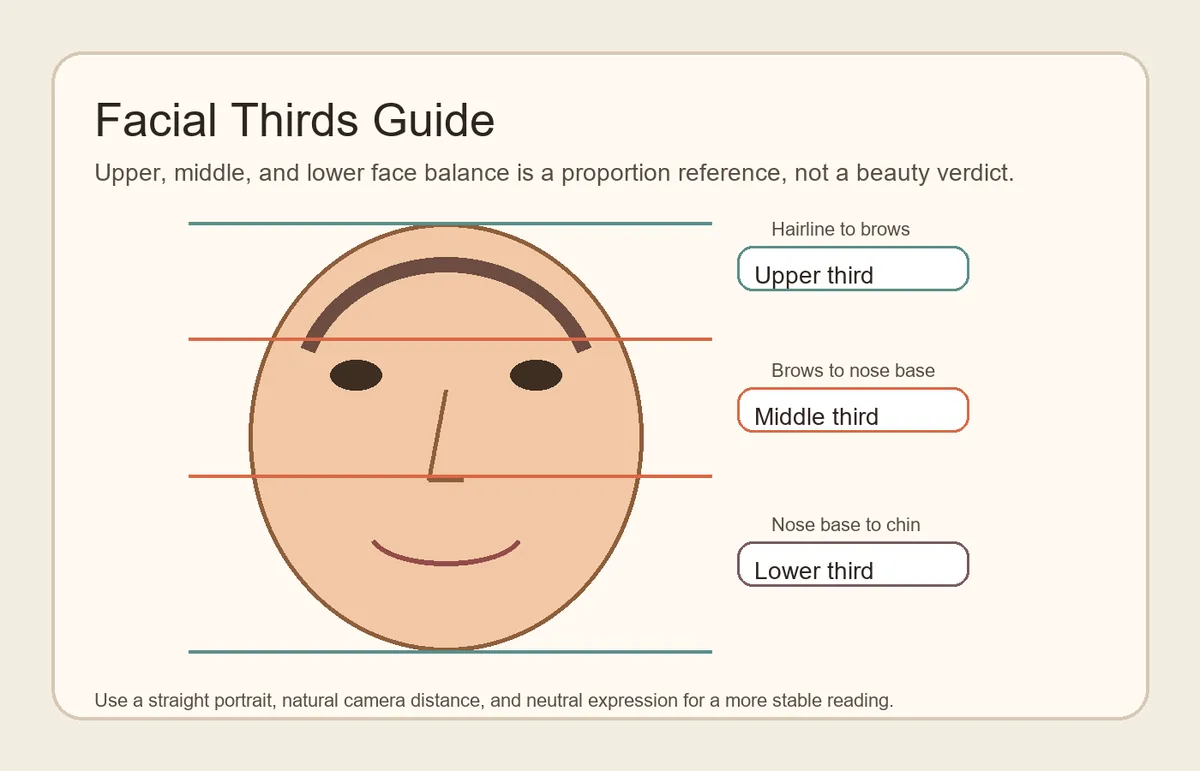
Facial thirds is one of the most common proportion ideas people run into when they start reading about face balance. The phrase sounds technical, but the basic idea is simple: look at the visible height of the upper, middle, and lower face, then ask whether those sections appear relatively even in the current photo.
That does not mean every balanced face has three identical measurements, and it definitely does not mean a small difference is a flaw. A facial thirds guide is most useful when it helps you understand why one portrait looks more harmonious than another, why a selfie may distort the lower face, or why a hairstyle changes how the forehead reads.
This page separates facial thirds from broader golden-ratio marketing. It answers the information intent first, then shows where symmetry tools and photo-based calculators fit.
What Are Facial Thirds?
Facial thirds divide the visible face vertically into three stacked zones: the upper third, the middle third, and the lower third. In most practical beauty or styling discussions, the upper third runs from the hairline to the brow area, the middle third runs from the brows to the base of the nose, and the lower third runs from the base of the nose to the chin.
The reason this concept appears so often is that people notice vertical balance quickly. If one section reads much longer or shorter in a photo, the face can look stretched, compressed, or visually weighted toward the top or bottom. That is why facial thirds often show up next to face ratio, jawline, and symmetry discussions.
A good facial thirds guide also has to admit the obvious limitation: the hairline is not always fixed, brows move with expression, and the lower face changes when you smile, tense the jaw, or tilt the head. In other words, facial thirds are useful, but they are still a photo-based approximation.
Key takeaway
Facial thirds are a proportion framework for reading vertical balance in a photo. They are not a medical diagnosis and not a universal beauty law.
How to Measure Facial Thirds in a Useful Way
Most readers searching for facial thirds want either a quick DIY explanation or a way to interpret what an online tool is showing them. The useful workflow is to work from a clear, front-facing portrait and use stable landmarks rather than guessing from a heavily angled selfie.
The exact landmarks vary slightly by source, but the practical goal stays the same: compare the visible height of the upper, middle, and lower sections, then interpret any difference in context rather than forcing a perfect number.
| Section | Typical landmarks | What can distort it |
|---|---|---|
| Upper third | Hairline to brow region | Receding hairline, bangs, camera tilt, lifted brows |
| Middle third | Brow region to base of nose | Head angle, lens distortion, strong shadows |
| Lower third | Base of nose to chin | Smile, open mouth, beard shape, chin angle |
- Use a straight portrait with both sides of the face visible.
- Keep expression neutral if you want the most stable lower-third reading.
- Do not compare two photos taken from very different distances as if they were identical measurements.
- Treat the result as a visible proportion clue, not an absolute truth about your face in real life.
What Equal Facial Thirds Actually Mean
Search results often treat equal facial thirds like a final beauty verdict, but that overstates the concept. Equal facial thirds simply mean the upper, middle, and lower face read relatively balanced in the current image according to the chosen landmarks.
That can be useful because balanced vertical spacing often makes a portrait feel calm and organized. It can also help explain why a hairstyle, beard line, contour placement, or camera angle changes your overall look. But it does not mean that every attractive face is mathematically equal, and it does not make natural variation a problem to be fixed.
Read balance before perfection
A close match among thirds suggests visual balance, not a flawless face.
Notice where the difference comes from
A longer upper or lower third may reflect hairstyle, expression, or lens angle rather than bone structure alone.
Compare across photos
The same face can look more even in one image and less even in another, which is why repeated photo checks are more useful than one isolated score.
Pair it with other cues
Facial thirds become more meaningful when read together with symmetry, face width-to-length ratio, and visible feature spacing.
Facial Thirds vs Golden Ratio, Symmetry, and Face Shape
One reason this topic deserves its own page is that users often mix several different ideas together. Facial thirds are not the same thing as golden ratio alignment, left-right facial symmetry, or face shape labels, even though those topics overlap in many tools.
The cleanest way to separate them is to ask what each method is trying to describe. Facial thirds focus on vertical balance. Symmetry focuses on left-right alignment. Golden ratio tools compare multiple proportion relationships. Face shape classification focuses on outline and contour.
Facial thirds
Best for understanding upper, middle, and lower face balance in a portrait.
Face symmetry
Best for checking whether visible features line up evenly across the facial midline.
Golden ratio
Best for comparing several proportion relationships at once, including facial thirds.
Face shape
Best for styling decisions tied to contour, haircut framing, and silhouette.
Why a Facial Thirds Reading Changes from Photo to Photo
A facial thirds guide should prepare you for variation, because online readers often assume a proportion result should be fixed. In reality, vertical balance cues can shift a lot depending on the image.
If the camera is too close, the center of the face may feel exaggerated. If the chin is raised, the lower face can read longer. If the forehead is partly covered, the upper third can appear shorter. These are not rare edge cases. They are normal reasons that two photos of the same person produce different readings.
Do not over-read one image
A single selfie can be informative, but it is not enough to define your permanent proportions with certainty.
The biggest photo variables
- Camera distance and wide-angle phone lenses
- Head tilt or chin lift
- Raised brows or a strong smile
- Hairline coverage, bangs, or hats
- Shadow hiding one landmark more than another
This is also why formal craniofacial or orthodontic assessments rely on standardized methods rather than a casual selfie. For broader context on face proportion analysis, see the overview from the National Library of Medicine archive and treat web tools as educational references instead of clinical measurement systems.
How to Use a Facial Thirds Result Well
The best use of facial thirds is practical. You can use it to compare portraits, notice when a haircut changes apparent forehead balance, or understand why one angle makes the chin look heavier than another. It is much less useful when it becomes a rigid score-chasing exercise.
If you want a stronger interpretation, combine the thirds reading with one or two adjacent tools instead of collecting random beauty labels. A symmetry test can show whether the face is reading evenly left-to-right, and a golden ratio calculator can add more proportion cues without pretending any single metric defines attractiveness.
- Use the result to compare photos or styling choices, not to label yourself permanently.
- Repeat the check with a neutral portrait if the first image is tilted or very close.
- Look for patterns across several images instead of reacting to one score.
- Treat extreme claims about perfect proportions with skepticism.
If you want to test the concept directly, start with our golden ratio face calculator.
If you want a deeper explanation of what online face-analysis tools can and cannot claim, the companion guide on what an AI face analyzer can really tell you covers that broader trust and interpretation question in detail.
Photo Tips for a More Reliable Facial Thirds Check
Because the query intent is strongly practical, readers usually need a short setup guide before they run a tool. These simple adjustments improve the odds that the thirds reading reflects the portrait rather than obvious camera noise.
| Do this | Why it helps |
|---|---|
| Use a front-facing portrait | Reduces perspective changes between upper and lower face |
| Keep the camera a natural distance away | Avoids exaggerating the nose, lips, and center face |
| Use even light | Makes landmarks easier to see |
| Keep expression neutral | Prevents the lower third from shortening or widening unnaturally |
How to Read the Result Without Turning It Into a Ranking System
One of the biggest gaps in competing content is interpretation. Many pages tell readers what facial thirds are, but they do not explain what to do with the answer. The most useful interpretation is comparative and contextual.
Ask whether the result explains something visible in your photos. Does a hairstyle reveal more forehead and lengthen the upper third? Does a smile shorten the lower third? Does a more distant portrait make the face feel more balanced? If the answer is yes, the reading is already useful.
Good result
A balanced reading means the portrait looks vertically even from the chosen landmarks.
Mixed result
A mixed reading means one section is visually longer or shorter, which may or may not matter depending on the photo goal.
Repeat result
A pattern seen across several clean portraits is more informative than one dramatic selfie.
Styling result
The reading becomes actionable when it helps with haircut framing, beard shape, contour, or photo selection.
Bottom Line
Facial thirds are worth understanding because they give you a simple framework for vertical balance. That framework can improve how you read portraits, how you compare tool outputs, and how you think about styling or photo setup.
They are not a final answer about beauty, and they are not strong enough to stand alone without context. The most honest way to use them is as one proportion signal among several.
Practical conclusion
Use facial thirds to explain what a photo is doing, then pair that insight with symmetry, ratio, and styling context instead of chasing a mythical perfect face.
Facial Thirds FAQ
References and Further Reading
Check Your Facial Thirds in a Live Tool
Use our golden ratio face calculator if you want to compare facial thirds with face ratio, harmony, and other visible proportion cues from one photo.